Tag: Workplace Analytics

  • Occupancy Analytics for Commercial Buildings in Canada: A PIPEDA-Safe Guide

    Occupancy analytics for commercial buildings in Canada has moved from a nice-to-have to a line item facilities and real-estate leaders defend in every budget review.

    With hybrid work now the norm in Toronto, Vancouver, Calgary and Montreal towers, the question is no longer “how many desks do we have?” but “how many of them are actually used, when, and by how many people?” Badge swipes and lease square-footage can no longer answer that.
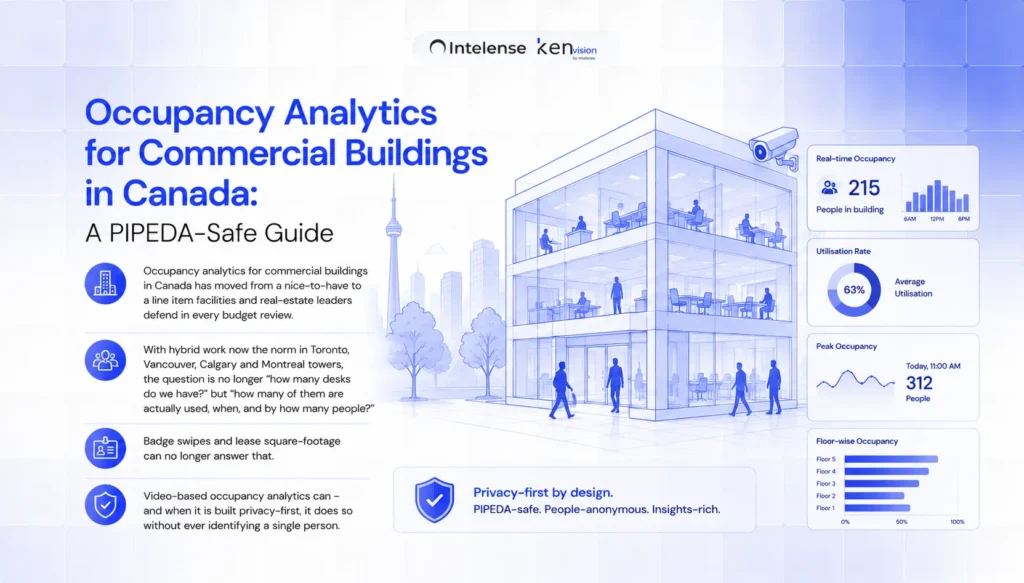
    Video-based occupancy analytics can — and when it is built privacy-first, it does so without ever identifying a single person.

    This guide explains how AI video analytics turns the cameras already installed in your building into an accurate, real-time occupancy sensor, how that maps onto Canada’s privacy framework, and what to look for before you deploy.
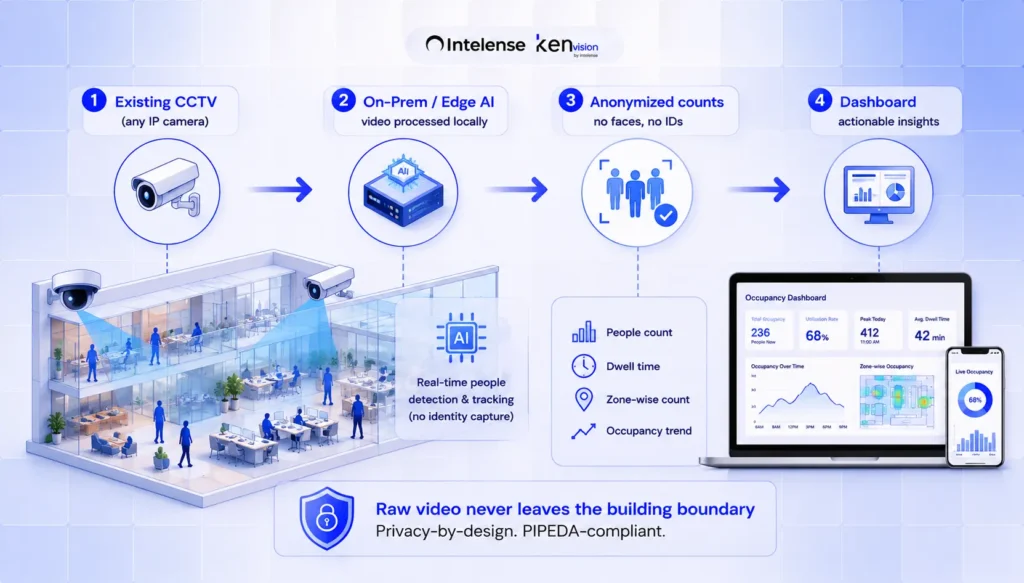

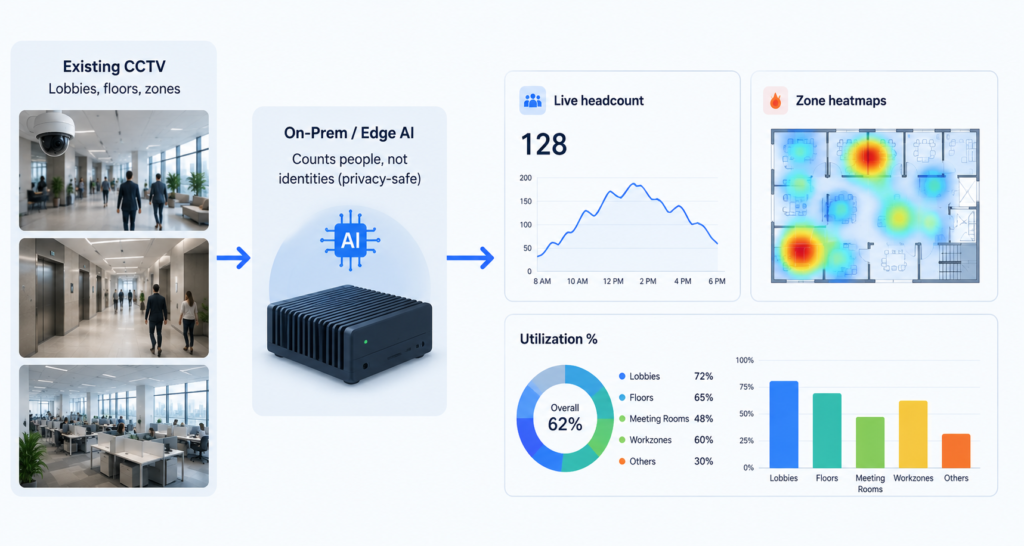
    Existing CCTV
    (any IP camera)

    On-Prem / Edge AI
    video processed locally

    Anonymized counts
    no faces, no IDs

    Dashboard
    Raw video never leaves the building boundary

    Why badge data and Wi-Fi counts fall short

    Most Canadian buildings still infer occupancy from access-control swipes, desk-booking software, or Wi-Fi association counts. Each has a structural blind spot.

    Badge data captures entries, not how long people stay or where they go once inside — and it misses tailgating, visitors, and anyone who props a door.
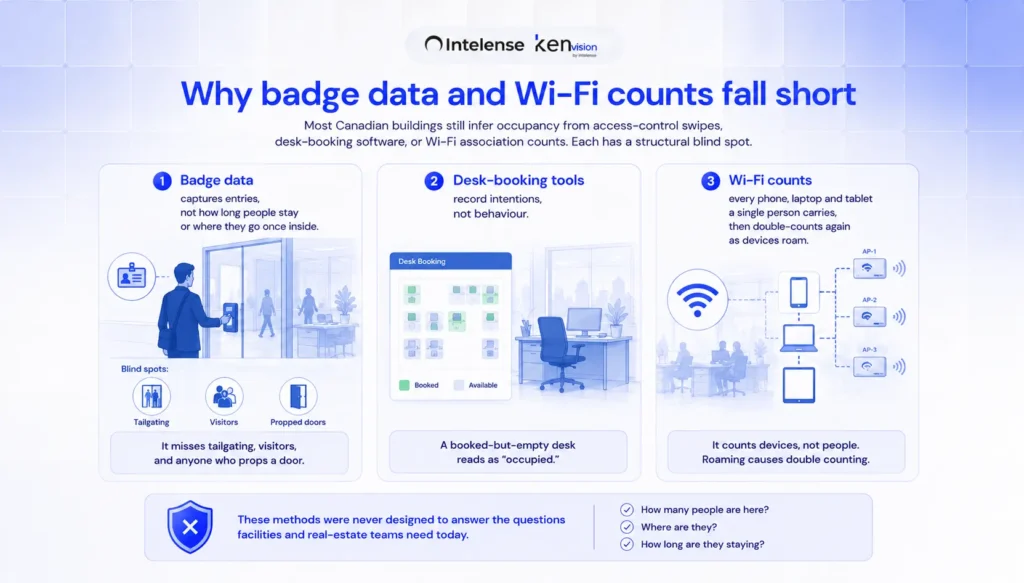
    Desk-booking tools record intentions, not behaviour; a booked-but-empty desk reads as “occupied.” Wi-Fi counts every phone, laptop and tablet a single person carries, then double-counts again as devices roam between access points.

    The result is occupancy figures that are confidently wrong, often by 20–40%. When a single floor in a downtown tower can cost millions a year, decisions about renewals, consolidation and fit-outs deserve a measured number, not an inferred one.

    What occupancy analytics actually measures

    AI video analytics counts people, not proxies.

    By applying computer-vision models to standard camera feeds, the system produces a continuous, time-stamped picture of how a building is really used: live headcount per floor or zone, peak and average occupancy by hour and day, dwell time in meeting rooms and collaboration areas, entry/exit flow at lobbies and stairwells, and the gap between booked and actually-used spaces.

    For a fuller primer on the underlying technology, see our pillar guide, What Is AI Video Analytics?
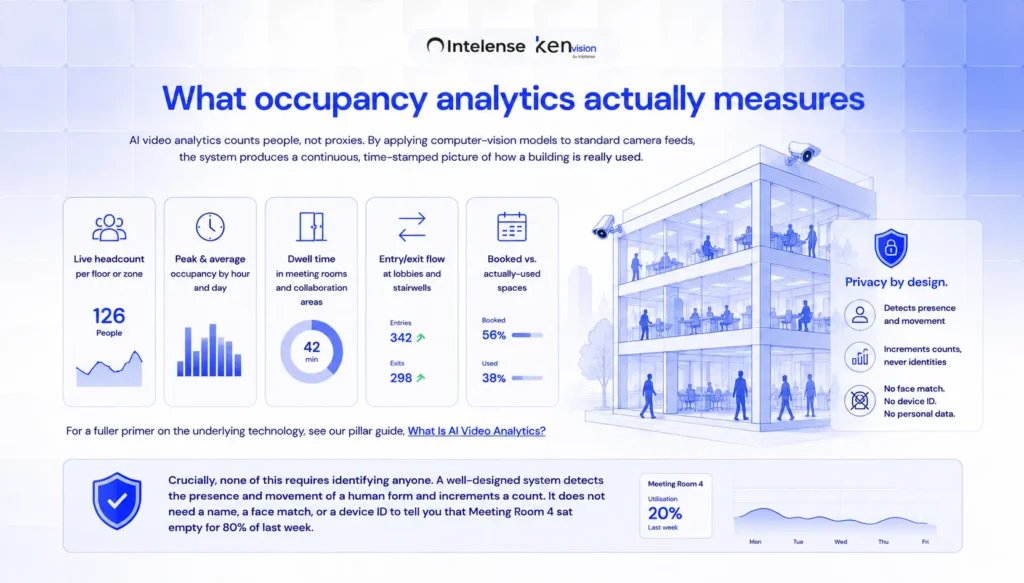
    Crucially, none of this requires identifying anyone. A well-designed system detects the presence and movement of a human form and increments a count.

    It does not need a name, a face match, or a device ID to tell you that Meeting Room 4 sat empty for 80% of last week.

    The Canadian privacy context: PIPEDA and beyond

    Canada’s Personal Information Protection and Electronic Documents Act (PIPEDA) governs how private-sector organizations collect, use and disclose personal information, with provincial regimes such as Quebec’s Law 25, British Columbia’s PIPA and Alberta’s PIPA layering on additional requirements.

    The pivotal concept for occupancy analytics is personal information: data about an identifiable individual. An anonymized count of how many people occupied a floor at 2 p.m. is not, on its own, personal information — provided the system never stores identifying imagery and the counts cannot be re-linked to a person.

    This is why architecture matters more than policy promises. A platform that streams raw video to a third-party cloud for processing creates exactly the kind of identifiable-data flow PIPEDA scrutinizes.
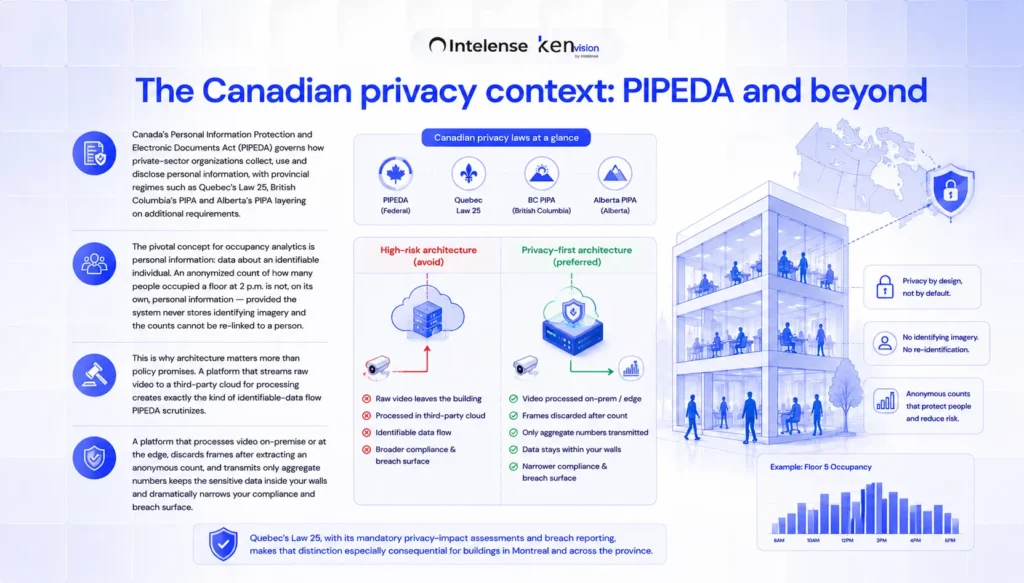
    A platform that processes video on-premise or at the edge, discards frames after extracting an anonymous count, and transmits only aggregate numbers keeps the sensitive data inside your walls and dramatically narrows your compliance and breach surface.

    Quebec’s Law 25, with its mandatory privacy-impact assessments and breach reporting, makes that distinction especially consequential for buildings in Montreal and across the province.

    A privacy-first, retrofit-friendly approach

    KenVision was built around the constraints Canadian facilities teams actually face. Four design choices make the difference:

    Works with your existing CCTV: There is no rip-and-replace. The system is camera-agnostic and layers analytics onto the IP cameras already covering your lobbies, floors and common areas, so a multi-tower portfolio can be instrumented without a capital project for new hardware. Our commercial buildings solution is designed specifically for this retrofit path.

    Privacy-first by architecture: Video is processed on-premise or at the edge. Raw footage stays within the building boundary, and only anonymized, aggregate occupancy data leaves it — aligning with PIPEDA’s data-minimization expectations and Law 25’s emphasis on privacy by design.
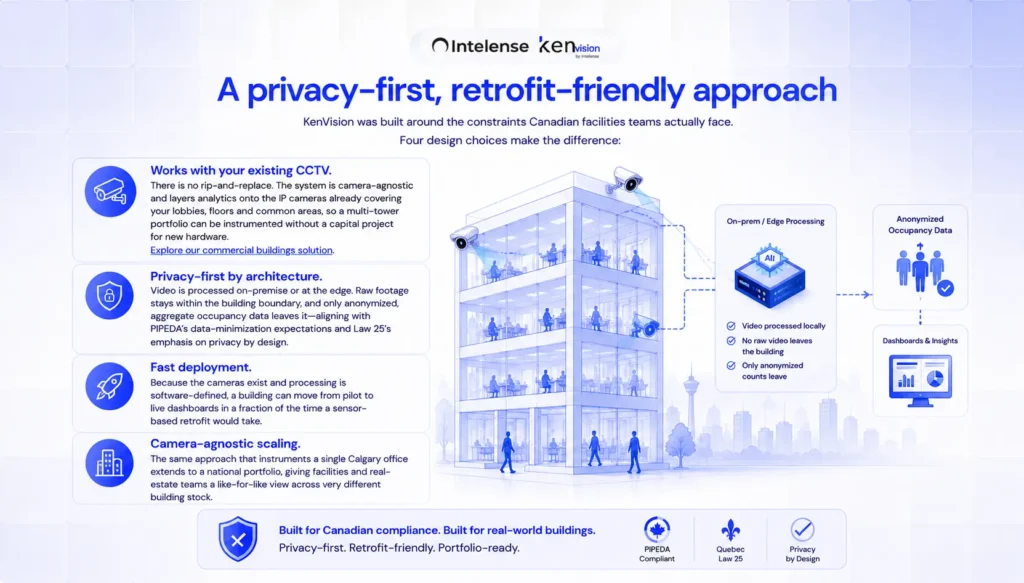
    Fast deployment: Because the cameras exist and processing is software-defined, a building can move from pilot to live dashboards in a fraction of the time a sensor-based retrofit would take.

    Camera-agnostic scaling: The same approach that instruments a single Calgary office extends to a national portfolio, giving facilities and real-estate teams a like-for-like view across very different building stock.

    What teams do with the data

    Accurate occupancy data pays for itself in three places.

    Real-estate rationalization: when you can prove a floor runs at 35% peak utilization, consolidation and sublease decisions stop being guesswork — a meaningful lever given Canadian commercial rents.

    Energy and HVAC: tying ventilation, heating and lighting to measured occupancy rather than a fixed schedule cuts energy use in zones that are empty for much of the day, supporting both cost and decarbonization targets.

    Experience and operations: knowing when the lobby, cafeteria or parking deck actually peaks lets you staff and service to demand instead of habit.
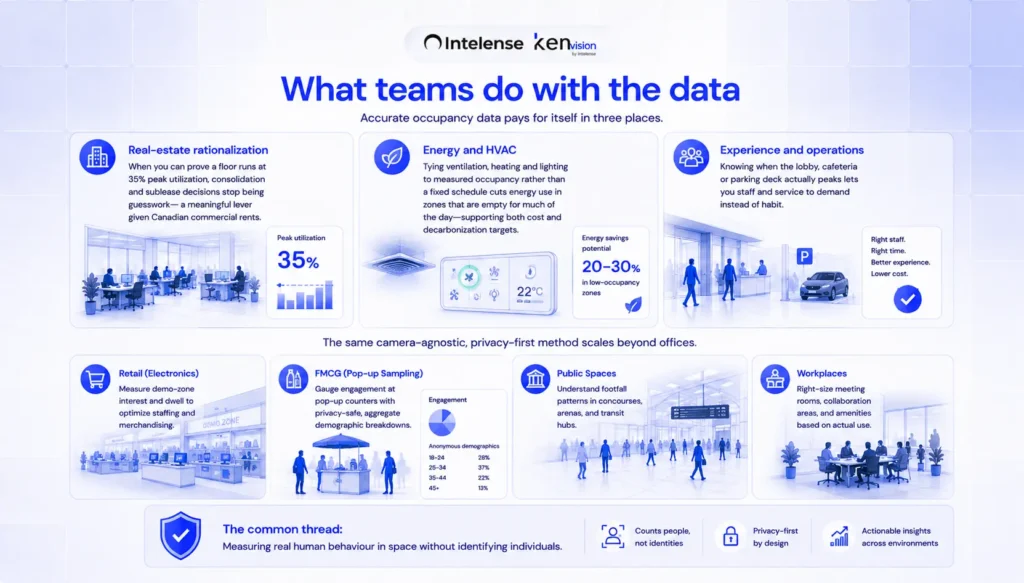
    The same camera-agnostic, privacy-first method scales beyond offices.

    Operators have used comparable approaches to understand engagement and footfall across very different environments — from a national electronics retailer measuring demo-zone interest, to a leading FMCG brand gauging engagement at pop-up sampling counters with privacy-safe, aggregate demographic breakdowns.

    The common thread is measuring real human behaviour in space without identifying individuals.

    Getting started

    A sensible pilot starts with one building or a representative floor, a clear baseline question (“what is our true peak occupancy versus our lease assumption?”), and a short list of zones that matter.

    Because the analytics ride on existing cameras, the pilot is low-risk and reversible. From there, the same configuration template extends across the portfolio.

    See how occupancy analytics would work on your existing cameras — book a 30-minute demo.

    Frequently asked questions

    Is video-based occupancy analytics legal under PIPEDA?

    Yes, when implemented correctly. PIPEDA regulates personal information about identifiable individuals.

    A system that produces only anonymized, aggregate counts — processing video on-premise and never storing identifying imagery — minimizes the collection of personal information.

    Organizations should still complete a privacy assessment, post appropriate notices, and document their data flows, and Quebec operators should account for Law 25’s privacy-impact-assessment requirements.

    Do we need to install new cameras or sensors?

    Generally no. The approach is camera-agnostic and retrofits onto existing IP CCTV, avoiding a rip-and-replace hardware project. Coverage gaps in specific zones can be addressed selectively rather than rebuilding the whole estate.

    How is this more accurate than badge or Wi-Fi data?

    Badge data counts entries, not presence or movement, and misses tailgating and visitors. Wi-Fi counts devices, not people, and double-counts roaming. Video analytics counts the people actually present in a zone over time, which is why it typically corrects occupancy estimates that other methods get wrong by 20–40%.

    Does the system store recordings of employees?

    In a privacy-first deployment, raw video is processed locally and discarded after an anonymous count is extracted; only aggregate numbers are retained. This keeps identifiable data inside the building and reduces both compliance and breach risk.

    How quickly can a building go live?

    Because the cameras already exist and processing is software-defined, deployment is fast — a single building can typically move from pilot to live dashboards far quicker than a sensor-based retrofit.
  • Occupancy Analytics for Commercial Buildings in India: Beyond Badge Data

    If you manage office towers, IT parks, or coworking floors in Bengaluru, Mumbai, Gurugram, or Hyderabad, you already have an occupancy number — it just isn’t a reliable one. Badge swipes, Wi-Fi associations, and desk-booking tools each tell a partial story. Occupancy analytics for commercial buildings in India goes beyond badge data by reading what is actually happening in the space: how many people are present, which zones fill up, when peaks hit, and how much of your leased area is genuinely being used. This guide explains how camera-based occupancy analytics works, where badge data falls short, and how facilities teams turn the resulting signal into lower energy bills, smarter leasing decisions, and better workplace experience.


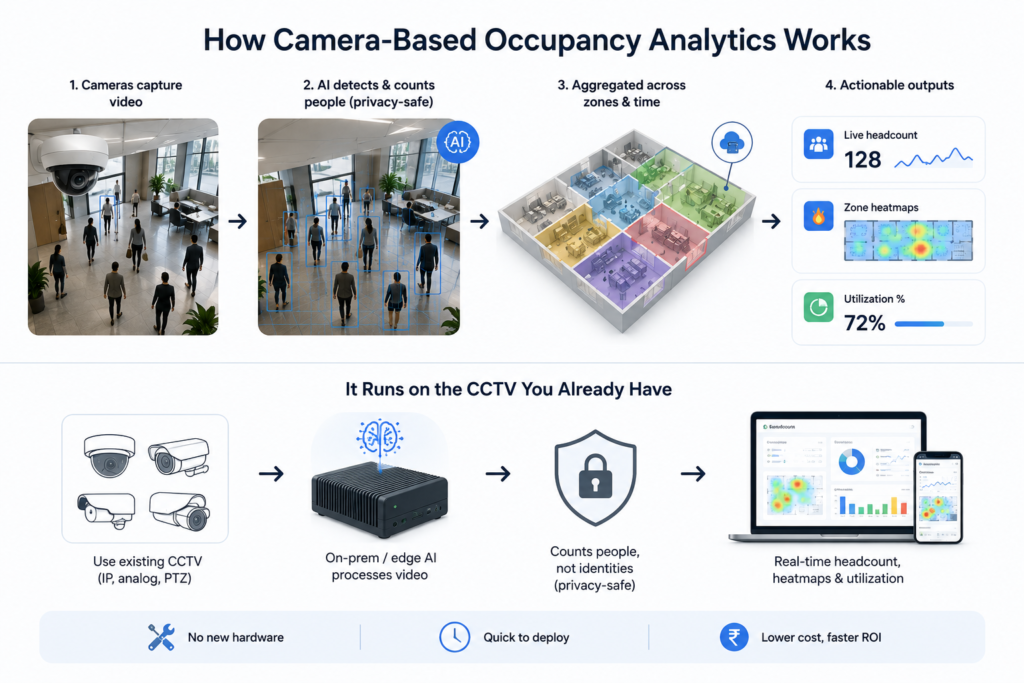
    How Camera-Based Occupancy Analytics Works


    No new cameras. No identity capture. Video processed on site and discarded.

    Why Badge Data Falls Short

    Access-control badges were designed to answer one question — “is this person allowed through this door?” — and they answer it well. They were never designed to measure occupancy, and in practice they understate it badly. In most Indian commercial buildings, one person badges in and holds the door for three colleagues. Visitors, contractors, housekeeping, and cafeteria staff often move through the building without ever swiping. Tailgating is the norm, not the exception. The result is a headcount that can be off by 30% or more on any given floor.

    The other common proxies are no better on their own. Wi-Fi association counts double-count anyone carrying a phone and a laptop, and miss guests on cellular. Desk-booking software tells you what people intended to do, not whether they showed up — a meeting room booked for twelve that seats four is invisible to the calendar. Each source has a blind spot, and stitching them together still leaves you guessing. Occupancy analytics closes the gap by measuring presence directly from the cameras you already have.

    How Camera-Based Occupancy Analytics Works

    The core idea is simple: computer-vision models detect and count people in a camera’s field of view, then aggregate those counts across zones and time. The system tracks how many people are present in a lobby, an open-plan floor, a cafeteria, or a meeting room, and how long they stay. It distinguishes a corridor that people merely pass through from a collaboration zone where they actually settle, using dwell time. Over days and weeks, this produces the three outputs facilities teams care about: real-time headcount, zone-level heatmaps of where people congregate, and a utilization percentage for every leased area.

    Critically, this is a counting task, not a recognition task. Good occupancy analytics counts bodies, not identities — there is no need to know who someone is to know that the third floor is at 80% capacity. That distinction matters enormously for privacy, and it is the foundation of a defensible deployment in India under the Digital Personal Data Protection (DPDP) Act, where minimising the personal data you process is both good practice and good law.

    It Runs on the CCTV You Already Have

    The biggest misconception is that occupancy analytics requires a sensor retrofit — ceiling-mounted people counters at every doorway, thermal arrays in every room. It doesn’t. Modern video AI is camera-agnostic and works with existing CCTV, so the cameras already watching your lobbies, lift bays, and floor plates can do double duty as occupancy sensors. There is no rip-and-replace, no civil work, and no months-long procurement cycle for new hardware. For a facilities team trying to justify a pilot, “use what’s on the ceiling already” is a very different business case from “buy and install a thousand sensors.”

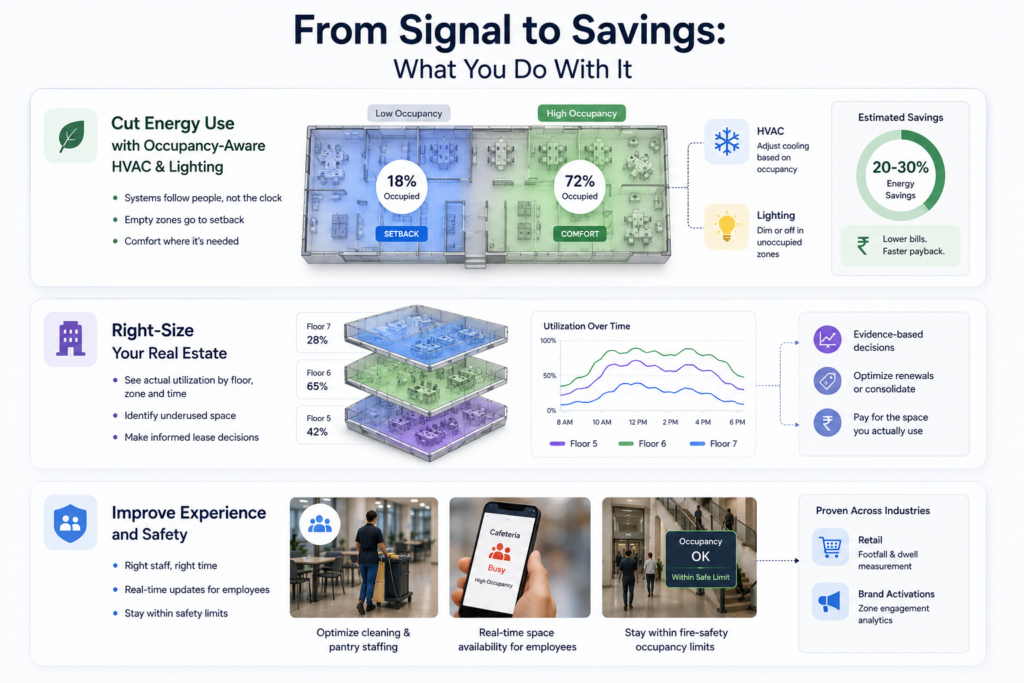
    From Signal to Savings: What You Do With It

    Cut Energy Use with Occupancy-Aware HVAC and Lighting

    Air-conditioning is the single largest controllable cost in most Indian office buildings, and it is routinely run to a fixed schedule that ignores reality — full cooling for a floor that is 20% occupied on a Friday, or for conference rooms sitting empty all afternoon. Feeding live occupancy data into your building management system lets HVAC and lighting follow people instead of the clock. Zones that are empty get setback; zones that fill up get conditioned before they become uncomfortable. In a climate where cooling loads dominate the bill, occupancy-aware control is one of the fastest paybacks in the building.

    Right-Size Your Real Estate

    Commercial rent in prime Indian micro-markets is expensive, and hybrid work has left many organisations paying for space they no longer fill. Utilization analytics gives leasing and workplace teams the evidence to act: which floors are chronically under 40% occupied, which neighbourhoods are oversubscribed at 9:30 but dead by 4:00, and whether a consolidation or a sublease is justified. Instead of negotiating a renewal on gut feel, you walk in with weeks of measured utilization per square foot.

    Improve Experience and Safety

    Live headcount also drives the everyday quality of the workplace. Facilities can position cleaning and pantry staff to actual peaks rather than a generic schedule, surface real-time “is the cafeteria packed right now?” signals to employees, and keep occupancy within fire-safety limits in assembly areas. The same generalized capability is already deployed in adjacent sectors — measuring footfall and dwell in retail, and zone engagement at brand activations — which is to say the underlying people-counting technology is mature and field-proven, not experimental.

    Doing It the Privacy-First Way in India

    Occupancy analytics touches a building full of employees and visitors, so the deployment model matters as much as the accuracy. A privacy-first architecture processes video on-premises or at the edge, inside your own network, and converts each frame into anonymous counts rather than storing or transmitting identifiable footage. Nothing about a named individual needs to leave the building. This aligns directly with the DPDP Act’s principles of purpose limitation and data minimisation: you are measuring occupancy, not surveilling people, and the system is built so that it cannot do the latter even if asked.

    On-prem and edge processing has a practical benefit too — it keeps bandwidth and cloud costs down, and it works even where connectivity to a head office or a foreign cloud region is unreliable or undesirable for compliance reasons. For multinational tenants operating in both India and markets like Canada, the same on-prem model satisfies the stricter of the two regimes by default. (For a deeper comparison, see our guide on regional analytics practice across markets.)

    Getting Started

    The fastest path to value is a focused pilot: pick one or two floors with existing cameras, run occupancy analytics for a few weeks, and compare the measured utilization against what your badge and booking data claimed. Almost every team is surprised by the gap. From there, the obvious next steps are wiring the live signal into your BMS for occupancy-aware HVAC and building a utilization dashboard for the leasing conversation. Because the cameras and the network are already in place, deployment is measured in days, not quarters.

    To understand the broader category and where occupancy fits alongside footfall, queue, and safety use cases, start with our pillar guide, What Is AI Video Analytics?, and explore the full commercial buildings solution from KenVision.

    Ready to see your real occupancy numbers? Book a 30-minute KenVision demo and we’ll show you how to turn your existing CCTV into a privacy-safe occupancy sensor — no new hardware required.

    Frequently Asked Questions

    How accurate is camera-based occupancy analytics compared to badge data?

    Because it counts people directly in each zone rather than inferring presence from door swipes, camera-based occupancy analytics avoids the tailgating, visitor, and held-door errors that make badge counts unreliable. It measures who is actually in a space, including people who never badge in.

    Do we need to install new sensors or cameras?

    No. The technology is camera-agnostic and works with your existing CCTV. The cameras already covering lobbies, floors, and common areas can be used as occupancy sensors, so there’s no rip-and-replace and no civil work.

    Is occupancy analytics compliant with India’s DPDP Act?

    A privacy-first deployment processes video on-premises or at the edge and produces anonymous counts rather than identifying individuals, aligning with the DPDP Act’s data-minimisation and purpose-limitation principles. Footage need not leave your building, and no personal identity data is required to measure occupancy. This is general information, not legal advice — confirm specifics with your compliance team.

    How does occupancy data reduce energy costs?

    Feeding live occupancy into your building management system lets HVAC and lighting respond to actual presence — setting back empty zones and conditioning busy ones — instead of running to a fixed schedule. In cooling-dominated Indian climates, this is one of the fastest-payback uses of the data.

    How long does a deployment take?

    Because it runs on existing cameras and on-prem or edge hardware, a focused pilot on one or two floors can be live in days rather than the months a sensor retrofit would require.