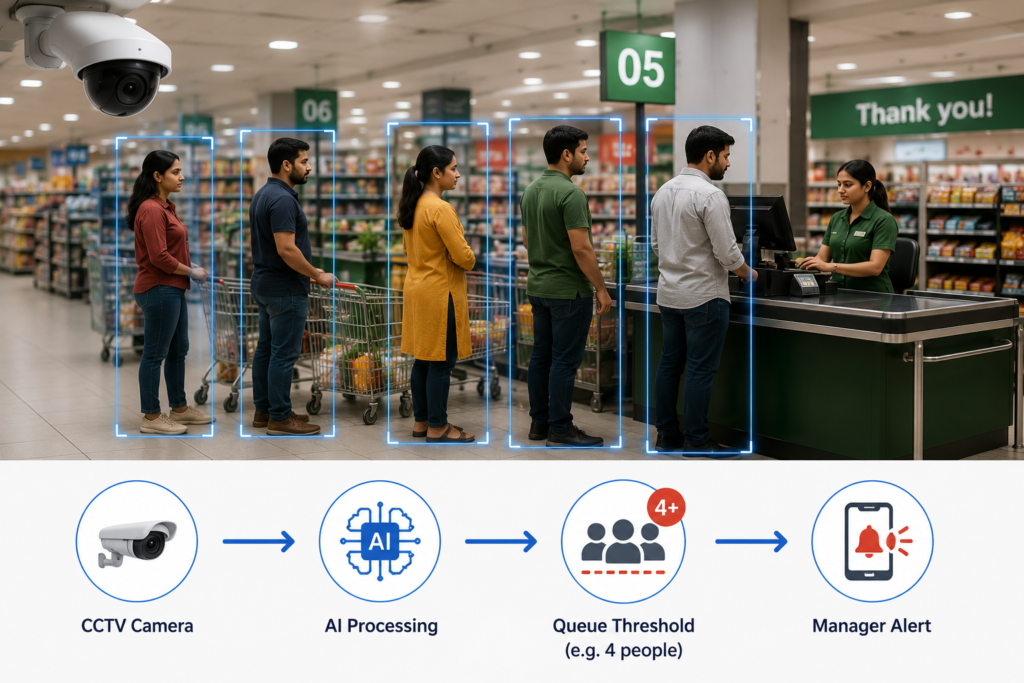
For Indian supermarkets, the checkout line is where a good shopping trip quietly turns into lost revenue. Shoppers fill a trolley, then balk at a five-deep queue and either abandon the basket or resolve never to return at peak hours. AI queue management for supermarkets turns the cameras you already run into a live sensor for checkout congestion — detecting queue build-up the moment it starts, alerting floor managers before customers walk out, and giving operations leaders the data to staff lanes to actual demand. This guide explains how it works, what it changes on the floor, and how to deploy it without ripping out a single camera.
Why checkout queues quietly cost Indian supermarkets
Indian grocery retail runs on thin margins and high footfall, and the checkout is the single most common friction point. Long lines at peak hours — evenings, weekends, and the days around salary credit and festivals — push shoppers to abandon full baskets, switch to a competitor across the road, or shift spend to quick-commerce apps. The damage rarely shows up cleanly in a report: a manager sees the day’s sales, not the trolleys left in an aisle. Queue analytics makes that invisible loss visible by measuring how long lines actually are, how long people wait, and how often congestion crosses the point where customers give up.
The traditional fixes are blunt. Over-staffing every lane all day destroys labour productivity; reacting only when a cashier radios for help is always too late. What store operations needs is an early-warning system tied to real demand — which is exactly what video AI provides.
How AI queue detection works
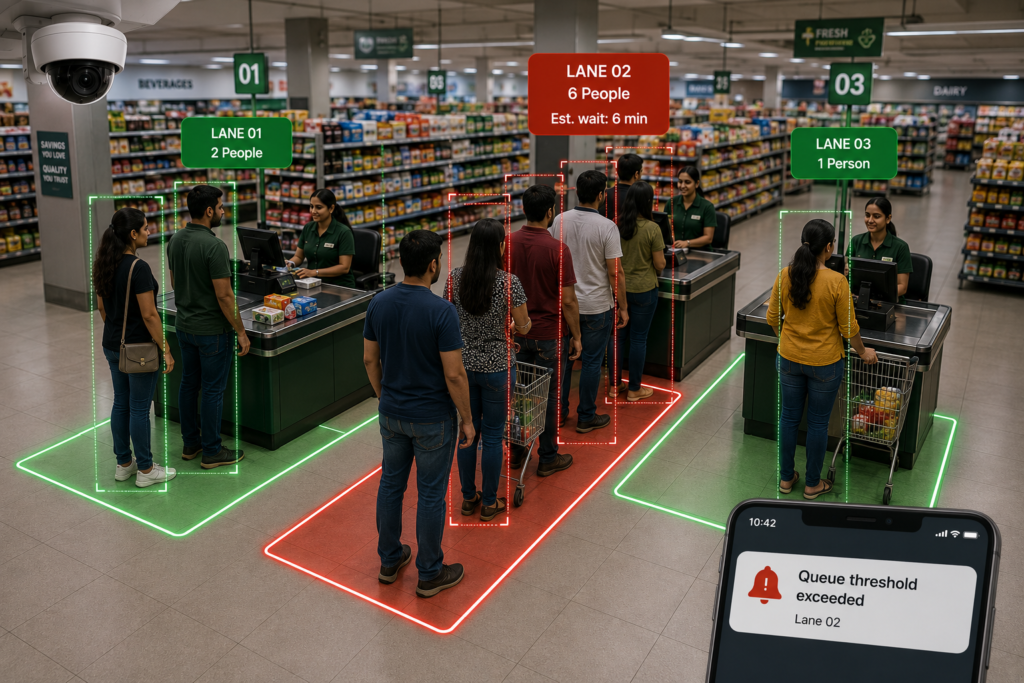
An AI queue management system applies computer-vision models to the live feed from cameras already pointed at the checkout zone. Rather than recording for later review, the models continuously answer operational questions in real time: how many people are waiting at each till, how the queue is growing, and how long the average shopper has stood in line.
Queue length and wait-time estimation
The system counts the people grouped at each checkout and tracks the line over time. Because it watches trends, not just snapshots, it can distinguish a brief cluster from a genuine build-up — and estimate wait time from how quickly the line is clearing.
Threshold-based alerts
Operators set a simple rule — for example, “more than four people waiting, or an estimated wait over three minutes.” When a lane crosses that threshold, the system pushes an alert to a floor manager’s phone or a back-office dashboard so a new till can be opened before customers abandon their baskets. The threshold is the lever: tighten it for premium formats, loosen it for high-volume value stores.
Patterns over time
Beyond live alerts, the same data builds a picture of when congestion repeatedly hits. That history is what lets a chain roster staff to genuine peaks instead of guesswork, and benchmark one store’s checkout experience against another.
Why KenVision fits Indian supermarket operations
KenVision is built for the realities of running stores in India, where camera estates are mixed, bandwidth is uneven, and privacy expectations are rising under the DPDP Act.
- Works with your existing CCTV. There is no rip-and-replace. KenVision is camera-agnostic and layers analytics onto the cameras already covering your checkout lanes, so you protect prior hardware investment.
- Privacy-first, on-prem and edge processing. Video is analysed on-site at the edge. The output is a count and an alert — not a library of shopper faces leaving the premises — which keeps you aligned with data-minimisation expectations.
- Fast to deploy. Because it reuses existing feeds, a pilot can light up in days, not the months a hardware-led project would take.
- One platform across use cases. The same deployment that watches queues can later cover footfall, dwell, and shrink, so the investment compounds.
For a broader primer on the technology behind these capabilities, see our overview of AI video analytics, and explore the full retail analytics solution for grocery and supermarket formats.
Turning queue data into checkout decisions
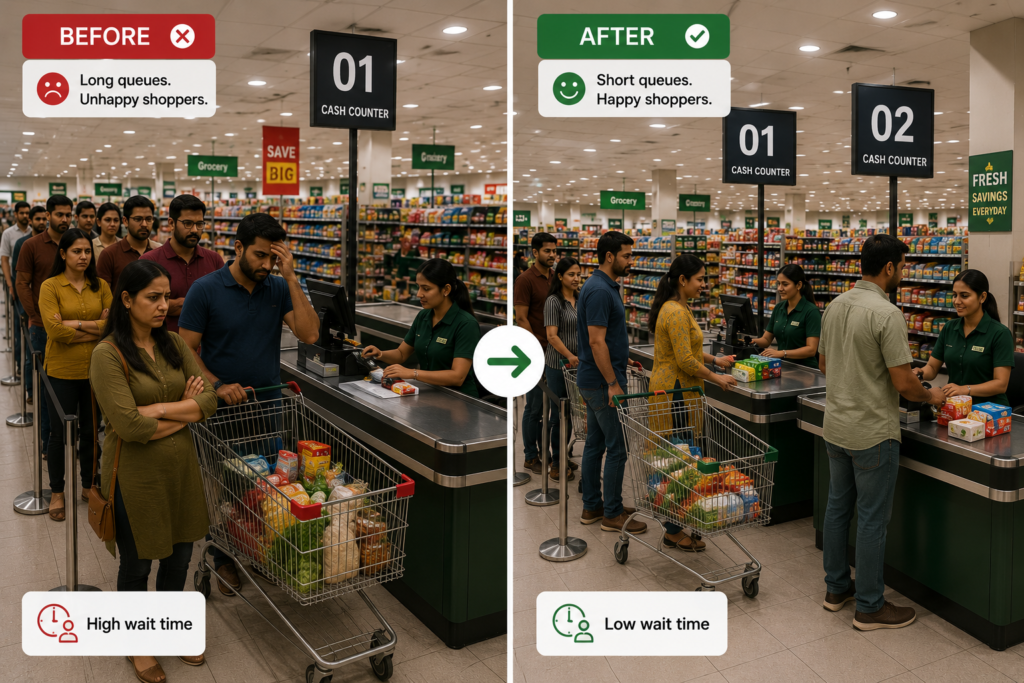
The point of measurement is action. In practice, store teams use AI queue management three ways. First, in the moment: alerts trigger a standard response — open a lane, redeploy a packer to bag faster, or route shoppers to a self-checkout bank. Second, in rostering: congestion-by-hour patterns let managers schedule cashiers against the days and time-bands that actually spike, instead of flat all-day cover. Third, at the chain level: comparing queue and wait-time metrics across branches surfaces which stores have a structural checkout problem — too few tills, poor layout, or persistent understaffing — versus a one-off bad day.
A national grocery operator running this approach can move from anecdote (“the Koramangala store felt slammed on Saturday”) to evidence (“lanes there breach the wait threshold every Saturday 6–8pm, and we are two cashiers short in that band”). That is the difference between reacting and managing.
Deploying without disruption
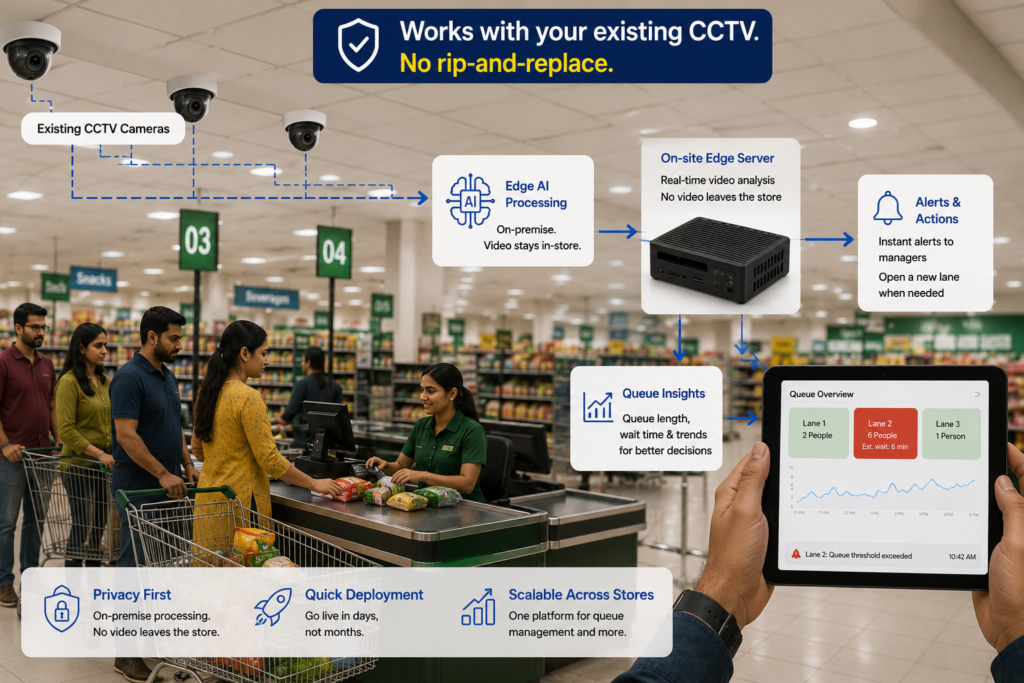
A sensible rollout starts with a single high-traffic store. Identify the cameras already viewing the checkout area, confirm their angles capture the queuing space, and define a first threshold based on what the floor team already knows about their peaks. Run it for a few weeks, tune the threshold against real shopper behaviour, and validate that alerts arrive early enough to act on. Once the response loop is working in one store, the same configuration template extends across the estate — and because processing stays on existing infrastructure, scaling is a software exercise, not a procurement cycle.
Conclusion
Checkout abandonment is one of the most fixable losses in Indian grocery retail, because the trigger — a line that grew too long before anyone acted — is now measurable in real time. AI queue management for supermarkets gives floor teams an early warning, gives schedulers real demand data, and gives leadership a like-for-like view across stores, all on the cameras already installed and with processing kept privately on-site.
See it on your own store footage. Book a 30-minute KenVision demo and we will show you how queue detection works with your existing CCTV.
Frequently asked questions
Do we need to buy new cameras for AI queue management?
No. KenVision is camera-agnostic and runs on your existing CCTV. As long as a camera already views the checkout queuing area at a usable angle, analytics can be layered on without new hardware.
Is shopper video sent to the cloud?
Not by default. KenVision processes feeds on-prem or at the edge, so analysis happens inside the store. The system produces counts and alerts rather than exporting raw shopper footage, which supports privacy-first operation under India’s DPDP Act.
How quickly can a queue alert reach staff?
Alerts are generated in real time as the queue crosses your chosen threshold and can be delivered to a manager’s phone or an in-store dashboard within seconds, so a new lane can open before customers abandon their baskets.
How do we set the right queue threshold?
Start with what your floor team already knows about peak behaviour — for example four people waiting or a three-minute wait — then tune over the first few weeks against actual abandonment patterns. Premium formats usually run tighter thresholds than high-volume value stores.
Can we compare checkout performance across multiple stores?
Yes. Because every store reports the same queue and wait-time metrics, you can benchmark branches against each other to find which have a structural checkout problem versus an occasional bad day.