Tag: KenVision Retail

  • Retail Footfall Analytics in India: A 2026 Playbook for Store Operators

    Retail footfall analytics in India has moved from a big-format luxury to an operational baseline. As organised retail expands across tier-1 metros and fast-growing tier-2 cities, store operators can no longer run promotions, rosters, and layouts on intuition alone.
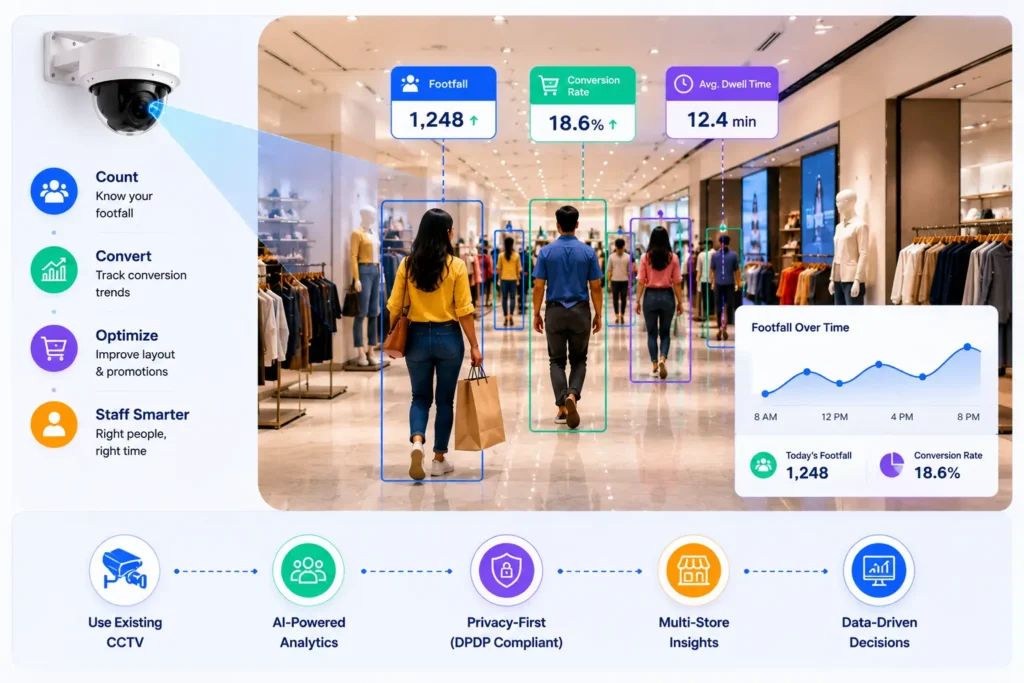
    The cameras are already on the wall; what changes in 2026 is the ability to turn that existing CCTV feed into reliable counts, conversion signals, and staffing decisions — without a costly hardware refresh and without compromising customer privacy.

    This playbook explains how retail footfall analytics works in the Indian context, the metrics that matter, the privacy obligations under the DPDP Act, and a practical rollout sequence you can follow across a multi-store estate.
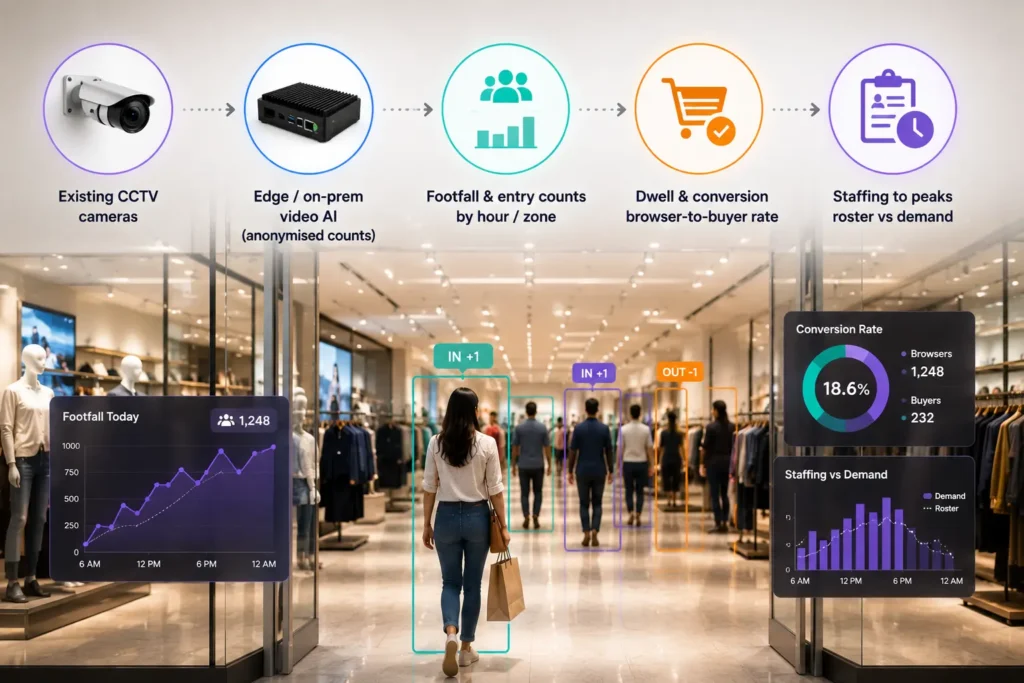
    Why retail footfall analytics matters more in India in 2026

    Indian retail is uniquely seasonal and uniquely diverse. A single chain may run flagship stores in Mumbai or Bengaluru alongside compact outlets in Jaipur or Coimbatore, each with different traffic rhythms.

    Festive peaks — Diwali, Eid, regional new-year sales — can swing daily footfall by multiples, and a roster built for an average week collapses under a festive Saturday.

    Footfall analytics replaces guesswork with an hourly demand curve per store, so managers staff the floor to actual traffic rather than to a fixed shift template.
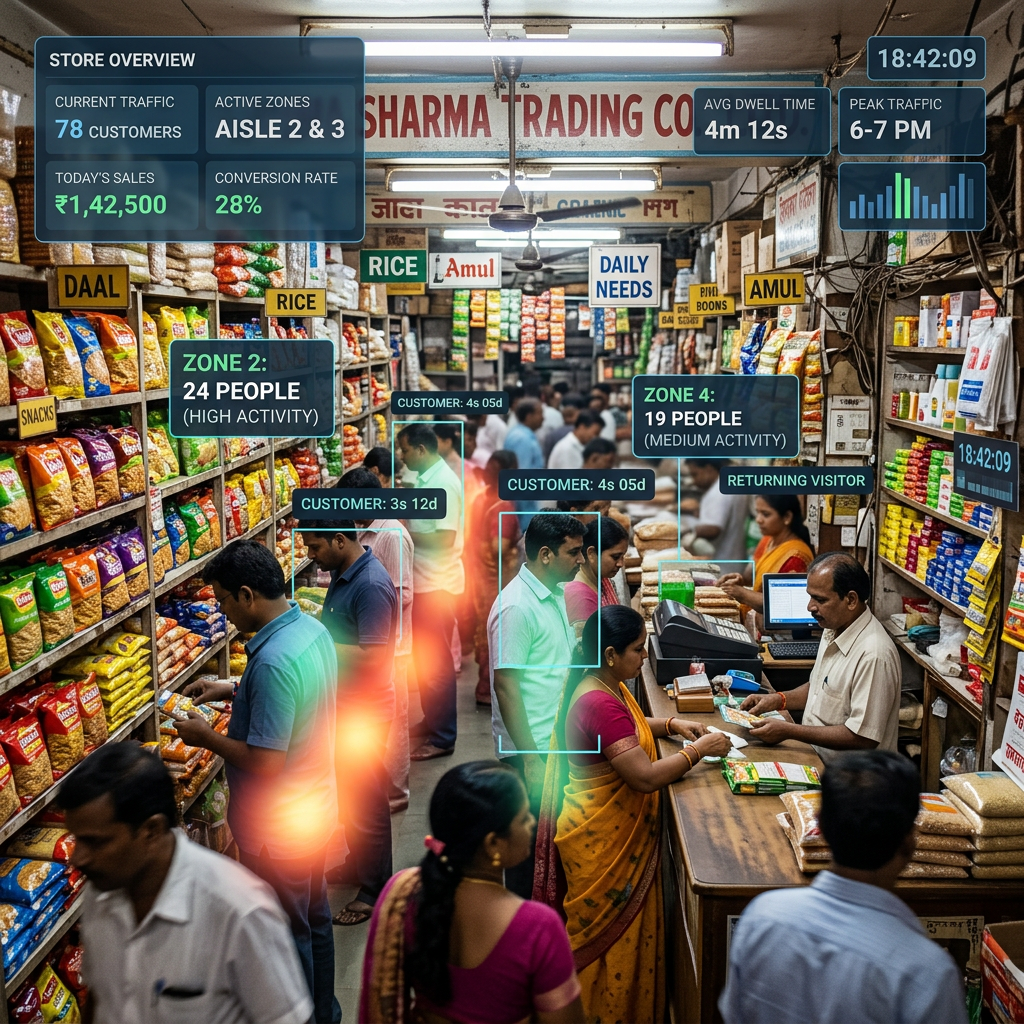
    Inside a busy retail store showing customers shopping with analytics data overlays including customer count, zone activity, sales, and time
    A busy retail store with real-time customer activity and sales data overlays

    The second pressure is margin. With rents and staffing costs rising in prime high streets and malls, operators need to know not just how many people entered, but how many converted.

    A store that pulls heavy footfall yet converts poorly has a layout, staffing, or assortment problem — and footfall data is what lets you tell those apart.

    How footfall counting works on your existing cameras
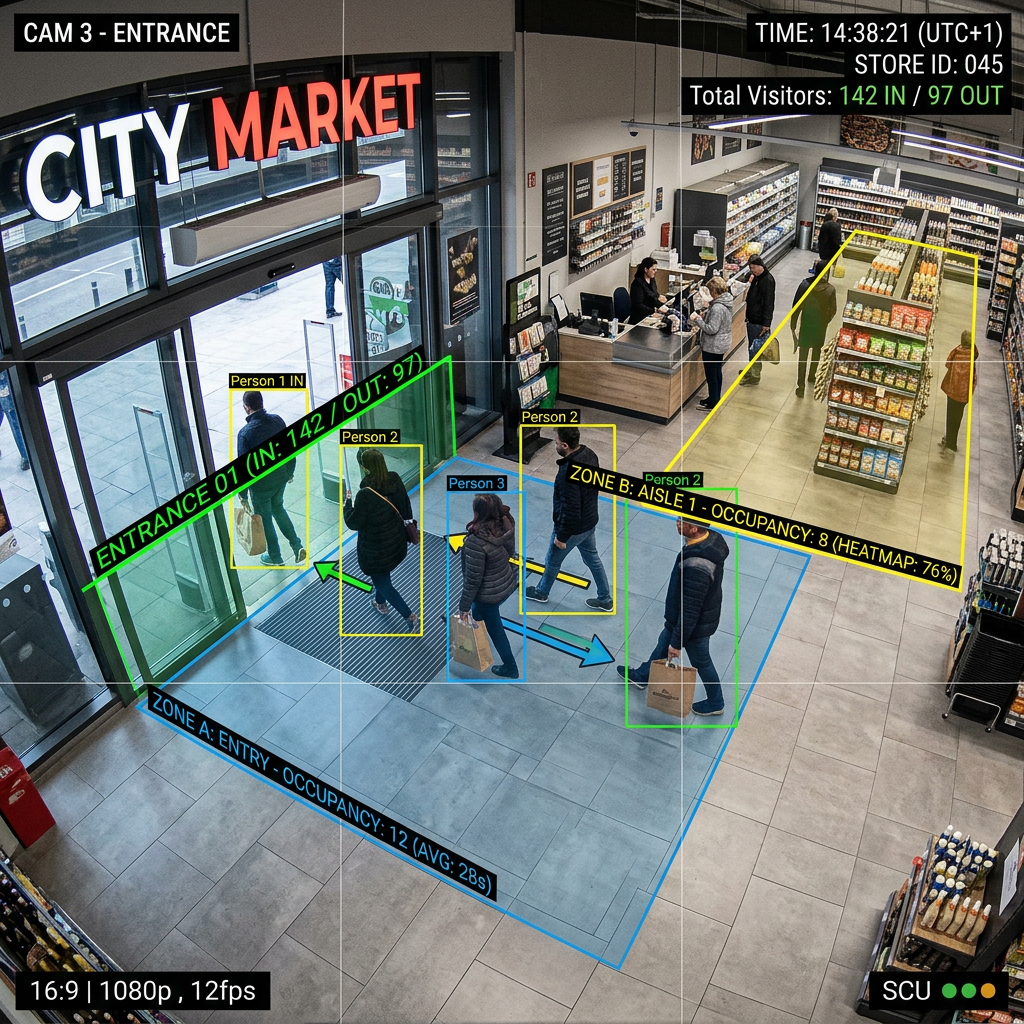
    Supermarket entrance with customers tracked by foot traffic and occupancy monitoring system
    People entering and shopping inside City Market with visitor tracking overlays

    Modern video AI does not require specialist sensors or door-mounted beam counters. It reads the feed from cameras you already operate.

    An entrance camera detects and counts people crossing a virtual line; in-store cameras segment the floor into zones and measure how long shoppers dwell in each.

    Because the analytics run on the video stream, the same infrastructure that records for security now produces operational intelligence.

    This camera-agnostic, retrofit approach is the fastest path to value — there is no rip-and-replace, and most stores can be live in days rather than months.

    For a deeper primer on the underlying technology, see our guide to what AI video analytics is and how it works, and the practical walkthrough of footfall counting on existing CCTV.

    Accuracy in Indian stores depends on a few real-world factors: camera height and angle at the entrance, glass-frontage glare in mall units, and crowding during peaks.

    A good deployment tunes counting lines per store rather than applying one template across the estate, and validates counts against manual spot-checks in the first weeks.

    The metrics that actually drive decisions

    Footfall on its own is a vanity number. The metrics that change behaviour are the ones that connect traffic to outcomes:
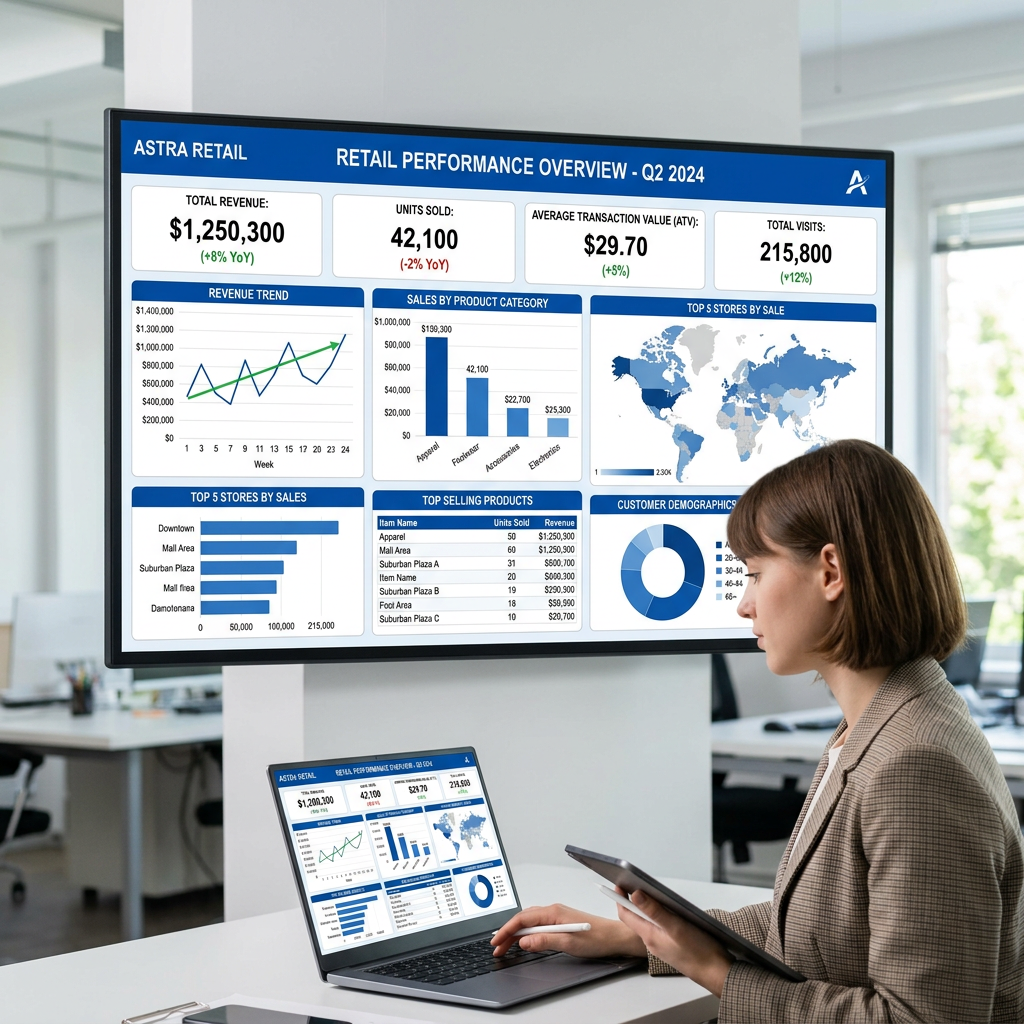
    Business analyst reviewing retail performance dashboard for Q2 2024 with sales, revenue, and demographics data
    A business analyst reviews Astra Retail’s Q2 2024 performance data on multiple screens
    • Entry count by hour and day: the demand curve that drives rostering and break scheduling.
    • Capture rate: the share of mall or high-street passers-by who actually enter — a direct read on your window, signage, and offer.
    • Zone dwell time: where shoppers linger, which tells you whether your best merchandise sits where attention concentrates.
    • Conversion rate: transactions divided by visitors, the single most important number for comparing stores fairly.
    • Staff-to-traffic ratio: whether the floor is covered when demand peaks, or over-staffed when it does not.

    Comparing conversion across a multi-store estate is where the strategy emerges. Two outlets with identical footfall but different conversion reveal exactly where to invest coaching, assortment, or layout changes.

    Heatmaps make the same point visually — if you are new to reading them, our explainer on retail store heatmaps and how to act on them is a useful companion.

    Privacy-first by design: footfall analytics and the DPDP Act

    India’s Digital Personal Data Protection Act, 2023, reshapes how retailers must handle anything that could identify a customer.

    The good news is that operational footfall analytics does not need to identify anyone. Counting, dwell, and conversion are aggregate measures — how many, how long, what share — not records of named individuals.
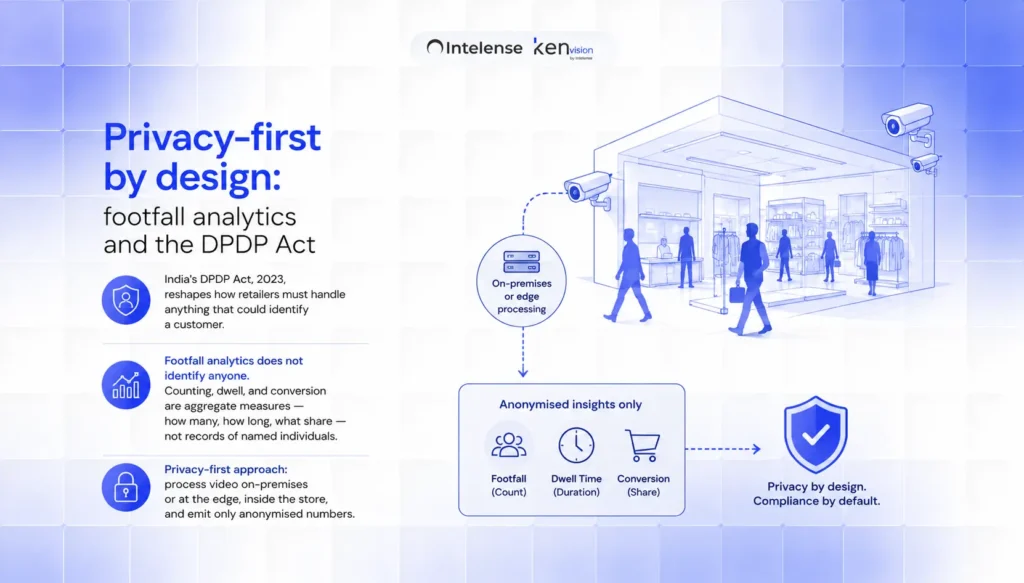
    The privacy-first approach that suits Indian retail processes video on-premises or at the edge, inside the store, and emits only anonymised numbers.

    Raw faces never leave the building, identities are not stored, and the analytics layer keeps counts rather than personal data. This on-prem, data-sovereignty-friendly design both reduces DPDP exposure and reassures customers.

    Where demographic breakdowns (such as approximate age band or gender split for a brand activation) are needed, they should be produced as anonymised, non-identifying aggregates rather than profiles tied to a person.

    A practical multi-store rollout sequence

    Operators get the best results by sequencing the rollout rather than switching everything on at once:

    • Weeks 1–2 — Pilot: pick three stores that represent your range (a flagship, a mall unit, a high-street outlet). Configure entrance counting lines and validate against manual counts.
    • Weeks 3–4 — Add depth: introduce zone dwell and conversion by integrating point-of-sale transaction counts, so you can compute conversion per store.
    • Month 2 — Scale: extend to the wider estate using the tuned templates from the pilot, and stand up a comparison dashboard.
    • Month 3 onward — Operationalise: tie staffing rosters to the demand curve, set conversion targets per store format, and review weekly.
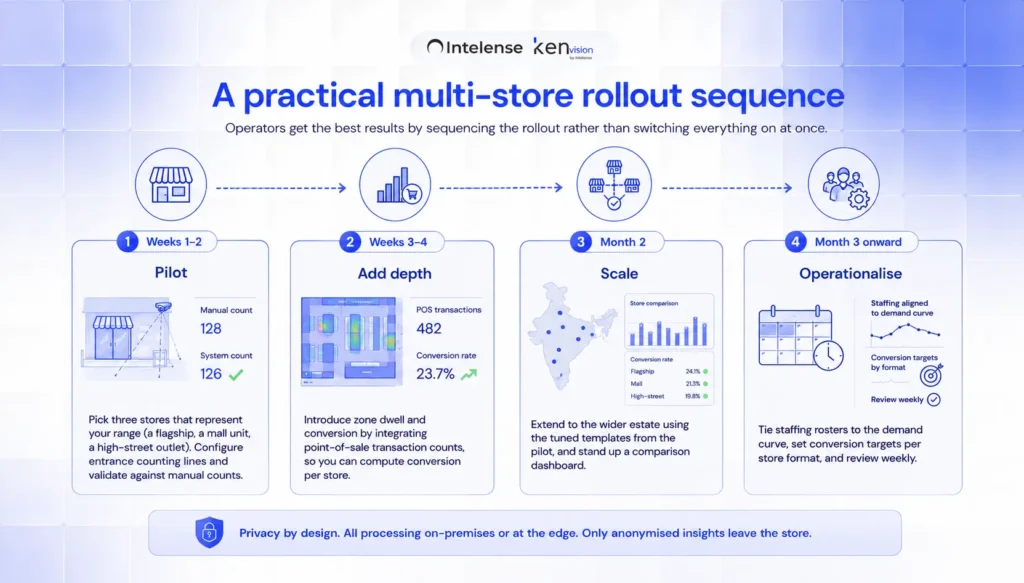
    Because the system runs on existing cameras, scaling is largely a software and configuration exercise rather than a capital project — which is what makes estate-wide deployment realistic on a retail timeline.

    You can see how this maps to specific store types on our retail analytics solution page.

    What good looks like across formats

    In practice we see the same patterns repeat. A national electronics retailer uses demo-zone dwell to convert browsers into buyers and to staff the floor to peak demo-hour traffic.

    A jewellery chain pairs footfall with behaviour alerts around high-value display cases, so the same cameras serve both merchandising and loss-prevention goals.
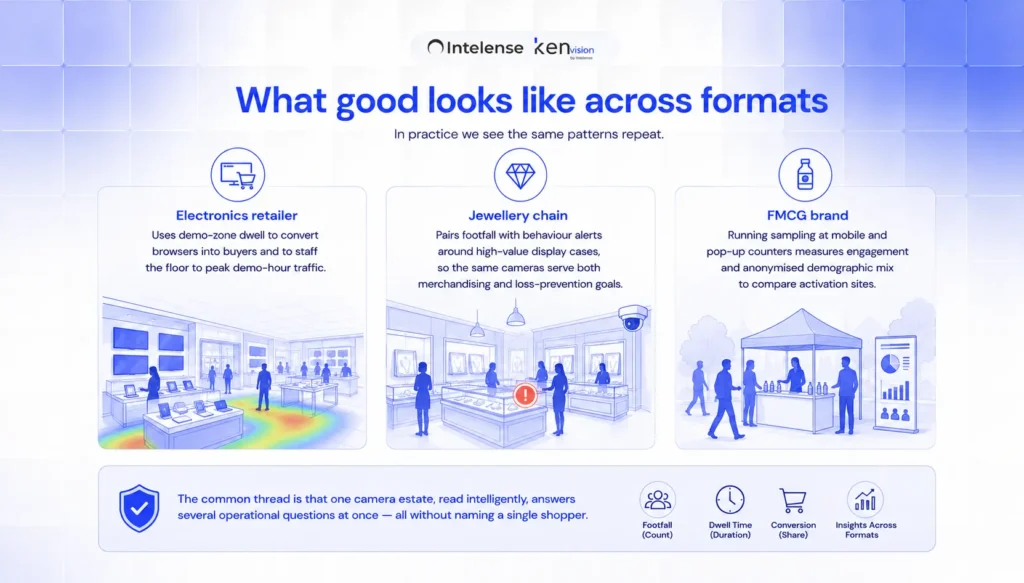
    A leading FMCG brand running sampling at mobile and pop-up counters measures engagement and anonymised demographic mix to compare activation sites.

    The common thread is that one camera estate, read intelligently, answers several operational questions at once — all without naming a single shopper.

    Getting started

    If you operate retail across Indian cities and your cameras are already in place, you are most of the way to a footfall analytics programme. Start with a focused pilot, prove conversion lift in a handful of stores, and scale on the evidence.

    To see how KenVision turns your existing CCTV into privacy-first footfall, dwell, and conversion intelligence, book a 30-minute demo.

    Frequently asked questions

    Do I need new cameras for retail footfall analytics in India?

    No. The analytics run on your existing CCTV feeds. The approach is camera-agnostic and retrofit-friendly, so most stores go live without buying new hardware, and entrance counting lines are simply tuned per store.

    Is footfall analytics compliant with the DPDP Act?

    It can be designed to be. Operational footfall, dwell, and conversion are aggregate counts rather than personal data. Processing video on-premises or at the edge and storing only anonymised numbers — never identities — keeps the system aligned with DPDP principles. Any demographic breakdowns should be produced as non-identifying aggregates.

    How accurate is camera-based footfall counting?

    With cameras positioned and tuned correctly, modern video AI delivers reliable entry counts suitable for staffing and conversion analysis. Accuracy depends on entrance camera angle, lighting, and crowding, which is why a good rollout validates counts against manual checks during the pilot weeks.

    How quickly can a multi-store chain deploy?

    A representative three-store pilot can be live within a couple of weeks, with estate-wide scaling over the following one to two months. Because it runs on existing cameras, deployment is mostly configuration rather than a capital hardware project.

    What is the difference between footfall and conversion?

    Footfall counts how many people enter; conversion is transactions divided by visitors. Footfall tells you about reach and traffic; conversion tells you how effectively the store turns that traffic into sales — which is the fairer way to compare stores of different sizes and locations.

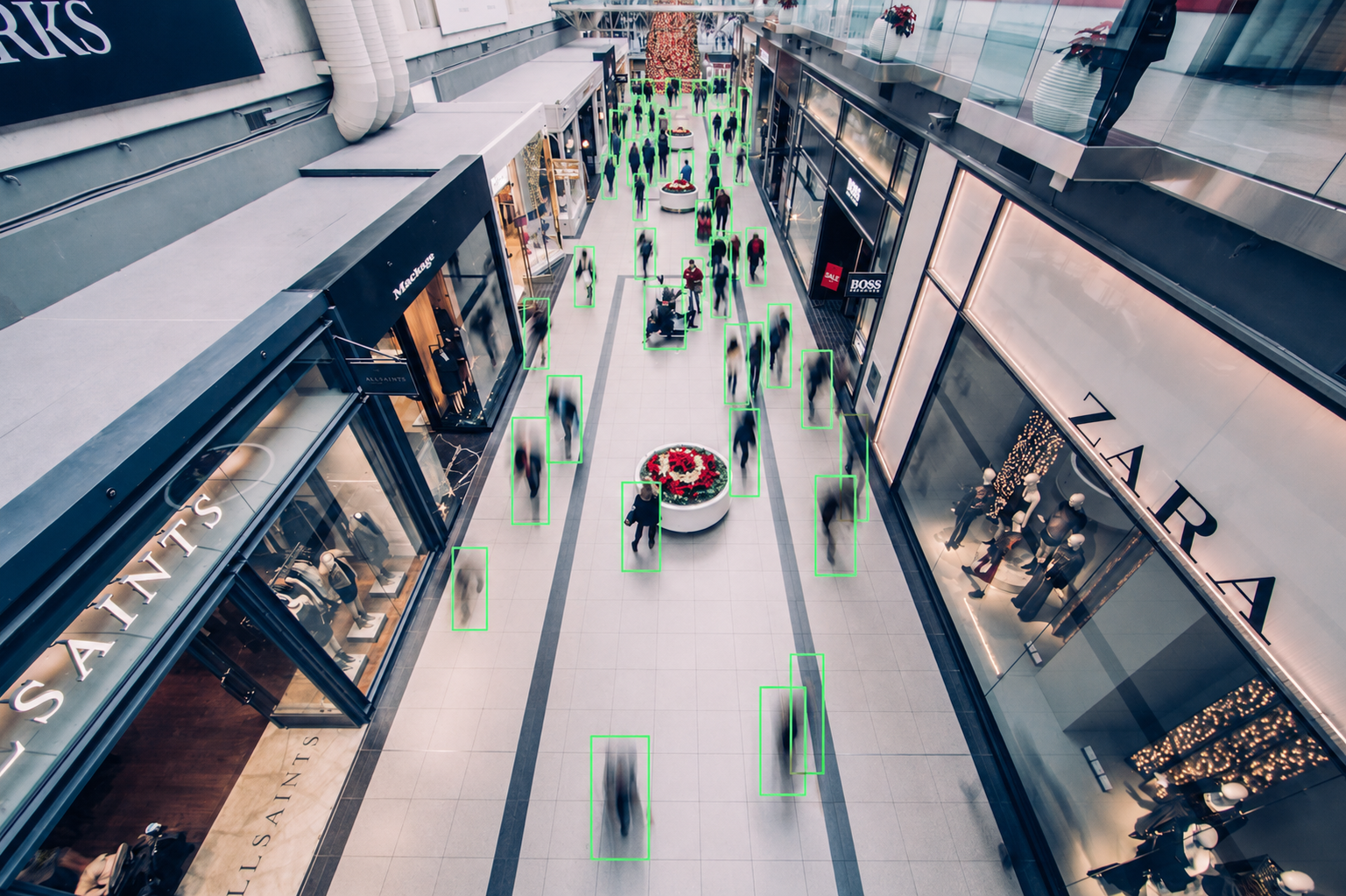
  • Retail Footfall Analytics in Canada: A 2026 Guide for Store Operators

    Retail footfall analytics in Canada has moved from a nice-to-have to a baseline operating tool.

    Rising occupancy costs, tighter labour budgets, and shoppers who research online before they walk in mean Canadian store operators can no longer run on POS data alone.

    Point-of-sale tells you who bought; it says nothing about the far larger group who walked in, looked, and left.

    Footfall analytics closes that gap by turning the cameras you already have into a continuous counter of demand, attention, and conversion.

    This guide explains how retail footfall analytics works in a Canadian context, what to measure, how to stay onside of privacy law, and how to get value from the CCTV already mounted in your ceilings.

    For the broader category, see our pillar overview, What Is AI Video Analytics?

    What retail footfall analytics actually measures

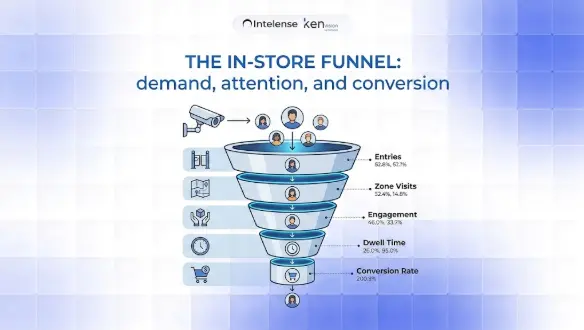
    At its simplest, footfall analytics counts how many people enter a store and when. Modern computer-vision systems go much further, distinguishing staff from shoppers, separating entries from exits, filtering out re-entries, and segmenting traffic by entrance. Layered on top of raw counts are the metrics that drive decisions:

    • Conversion rate — transactions divided by visitors, the single most important number most Canadian retailers still do not track in real time.
    • Dwell and zone engagement — how long shoppers linger in departments or in front of specific displays.
    • Peak-hour curves — the hourly and day-of-week rhythm that should drive staff scheduling.
    • Capture rate — for mall and high-street stores, the share of passing traffic that comes inside.

    Anonymous, privacy-safe demographic estimates (broad age band and gender) can also be derived to understand who a category attracts, without ever identifying an individual. Together these turn a store from a black box into a measurable funnel.

    Why 2026 is the inflection point for Canadian retail

    Three forces are converging.

    • First, labour: with minimum wages rising across provinces, every scheduled hour has to be justified, and aligning staff to actual traffic peaks is one of the fastest ways to protect both service and margin.
    • Second, real estate: landlords and head offices increasingly want evidence of foot traffic and capture rate to negotiate rent and justify locations.
    • Third, omnichannel: as more purchase research happens online, the in-store job shifts to conversion and experience — which you cannot improve if you cannot measure it.

    Privacy-first by design: PIPEDA and provincial rules

    Canadian retailers operate under the federal Personal Information Protection and Electronic Documents Act (PIPEDA), and in some provinces under substantially similar laws such as Quebec’s private-sector regime (including Law 25), British Columbia’s PIPA, and Alberta’s PIPA.

    The throughline is consent, purpose limitation, and data minimization.

    The good news for footfall analytics is that well-designed systems are inherently privacy-respecting: they convert video into anonymous counts and trajectories and discard or never store identifying imagery.

    The practical implications for a compliant deployment are straightforward.

    Process video on-premise or at the edge so raw footage never leaves the store.

    Output statistics — counts, dwell times, anonymized demographic bands — rather than face templates or identities. Post clear notice that analytics is in use, as you already do for security cameras.

    KenVision is built around exactly this model: processing can run on local or edge hardware so personal data stays inside your four walls, which makes the data-sovereignty conversation with a Canadian privacy officer far simpler.

    You can read more on the approach in our overview of privacy-first video AI.

    You do not need new cameras

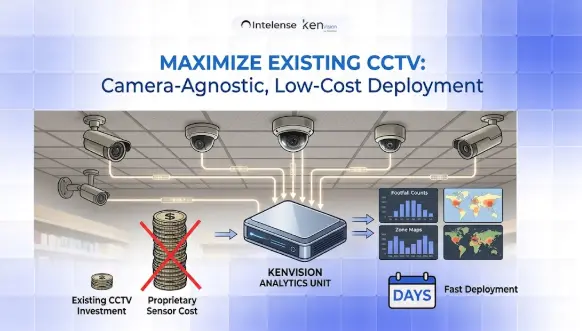
    The most common objection — “we would have to rip out our CCTV” — is usually wrong. Footfall analytics can run on the existing IP cameras most Canadian stores already have, provided they offer a reasonable view of entrances and key zones.

    A camera-agnostic, software-led approach means the analytics layer ingests existing feeds rather than demanding a proprietary sensor at every door.

    That keeps capital cost low, shortens deployment to days rather than months, and avoids the disruption of construction in a live store.

    Where coverage gaps exist — a poorly angled entrance camera, say — you add a single device rather than re-cabling the building.

    From counts to action: what good operators do

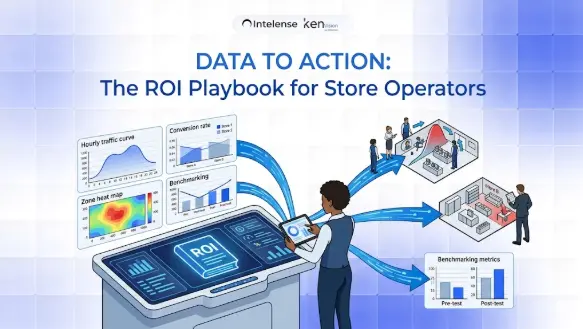
    Numbers only matter if they change behaviour. The retailers getting return from footfall analytics tend to run the same playbook.

    They schedule staff to traffic curves, not to habit, so the busiest 90 minutes are never under-covered.

    They set and watch conversion rate by store and by daypart, then investigate outliers — a store with high traffic and low conversion is usually a staffing, layout, or stock problem you can fix.

    They test layout and display changes as genuine experiments, comparing dwell and conversion before and after.

    And for chains, they benchmark locations against each other to spread what works. For a deeper toolkit by use case, see our retail analytics solutions.

    What this looks like in the field

    Real deployments show the range. A national electronics retailer used demo-zone engagement and footfall data to see where browsers clustered and to move staff toward those peaks, converting more lookers into buyers.

    A jewellery chain combined footfall context with suspicious-behaviour alerting around high-value display cases, standardizing how teams respond.

    A leading FMCG brand measured sampling-counter performance across mobile and pop-up locations, including an anonymized age-and-gender read of who engaged.

    The common thread is that the camera infrastructure was already there; analytics simply made it legible.

    A pragmatic rollout sequence

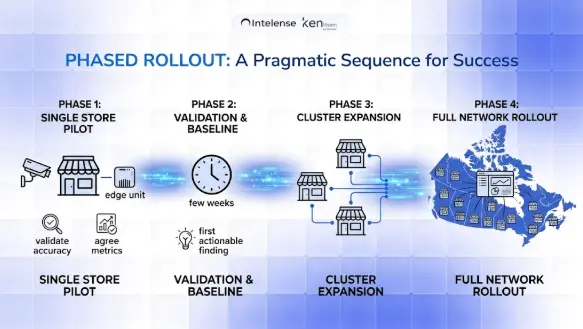
    Start with a single store or a small cluster.

    Confirm camera placement at entrances and two or three priority zones.

    Stand up edge processing, validate counting accuracy against a manual spot-count, and agree the two or three metrics leadership will actually look at — usually footfall, conversion, and peak coverage. Run for a few weeks, act on the first obvious finding (almost always a staffing-to-traffic mismatch), and only then expand.

    This keeps the project honest and the ROI visible before you scale across the network.

    Conclusion

    For Canadian store operators, retail footfall analytics in 2026 is the most accessible lever for improving conversion, right-sizing labour, and defending real-estate decisions — and it can be done in a privacy-first, PIPEDA-aligned way on the cameras you already own.

    The barrier is no longer technology or cost; it is simply deciding to measure the 90% of demand that POS never sees.

    See it on your own store footage. Book a 30-minute KenVision demo and we will walk through what footfall, conversion, and zone analytics would look like on your existing CCTV.

    Frequently asked questions

    Is camera-based footfall counting legal in Canada?

    Yes, when done with proper notice and data minimization. PIPEDA and provincial laws focus on consent, purpose, and not retaining personal information. Systems that output anonymous counts and process video on-premise — rather than storing identities — align well with these requirements. Always post notice and document your purpose.

    Do I need to replace my existing CCTV cameras?

    Usually not. If your IP cameras give a reasonable view of entrances and key zones, a camera-agnostic analytics layer can run on those feeds. You typically only add hardware to cover a specific blind spot.

    What is a good retail conversion rate to aim for?

    It varies widely by category — convenience and grocery run very high, big-ticket and specialty much lower. Rather than chase an industry number, establish your own baseline by store and daypart, then improve against it.

    How accurate is AI footfall counting?

    Modern computer-vision counting at well-placed entrances is highly accurate and validated against manual spot-counts during setup. Accuracy depends mostly on camera angle and coverage, which is why placement review is part of any serious rollout.

    How quickly can footfall analytics be deployed?

    Because it runs on existing cameras with edge processing, a single store or pilot cluster can typically be live within days, with network-wide rollout following once the metrics prove out.