AI theft detection for jewellery stores in India is moving from a luxury to an operational baseline. Gold and diamond showrooms across the country carry extraordinary value density on the shop floor — a single display tray can hold more stock than an entire FMCG aisle — yet most still rely on a guard, a panic button, and hours of CCTV nobody watches until after a loss. The result is shrinkage that surfaces only at stock-take, and incidents that are reconstructed rather than prevented. AI video analytics changes the timing: it watches every camera continuously and flags suspicious behaviour around high-value cases while it is happening, so staff can respond in the moment.
This guide explains how AI theft detection works in an Indian jewellery retail context, what it can and cannot do, and how to deploy it without ripping out the cameras you already own.
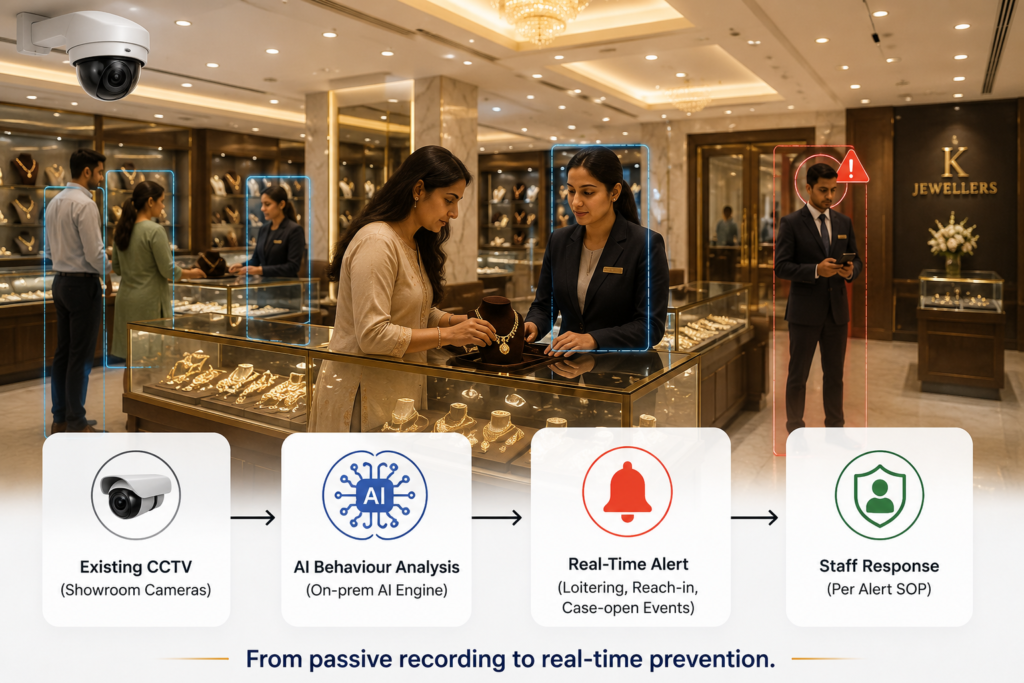
Why jewellery retail is a special case
Most retail analytics is about turning browsers into buyers. Jewellery shares that goal, but it carries a second, heavier mandate: loss prevention on goods where a single item can be worth lakhs. Indian showrooms also run a distinctive operating pattern — long dwell times at the counter, family groups, festival and wedding-season surges, and staff who must handle open stock face to face with customers. That mix makes traditional rules-based security brittle. A motion sensor cannot tell a legitimate try-on from a grab, and a guard watching one entrance cannot see a distraction play unfolding at a side counter.
AI video analytics is built for exactly this ambiguity. Instead of tripwires, it models behaviour: how long a person lingers at a case, whether multiple people coordinate to occupy staff, when a display is opened and by whom, and whether someone is paying unusual attention to the back of a counter. For a deeper primer on the underlying technology, see our pillar guide, What Is AI Video Analytics?
What AI theft detection actually watches for
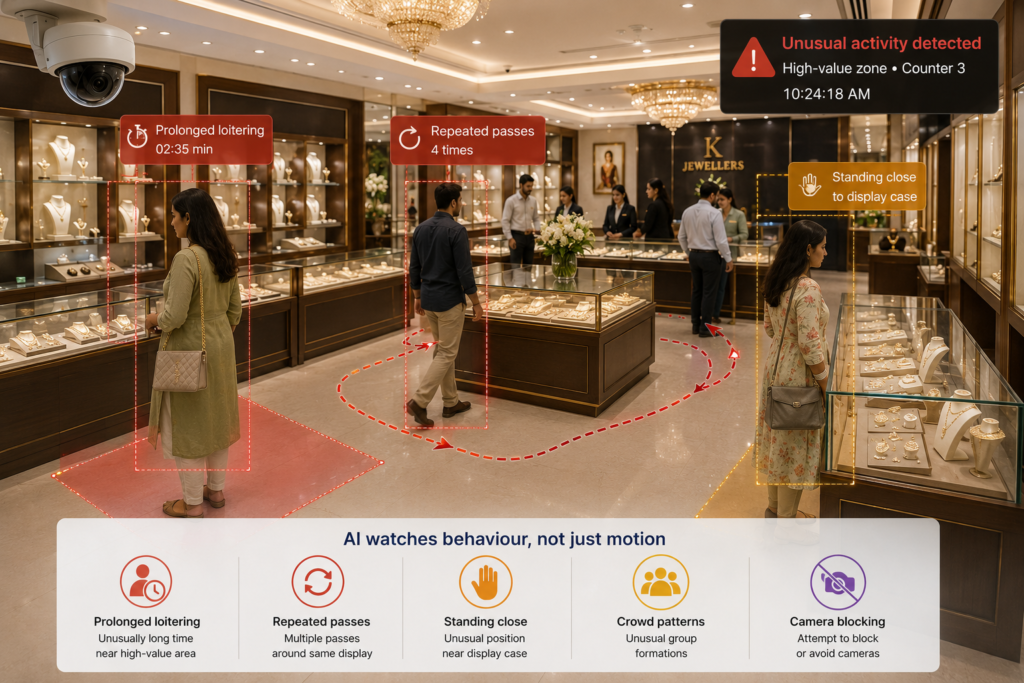
Suspicious behaviour and loitering
The system establishes what normal looks like at each zone — entrance, counter, billing, display wall — and surfaces deviations. Prolonged loitering near a high-value case without staff engagement, repeated passes past the same display, or a person positioning to block a camera or a colleague’s line of sight all generate a graded alert rather than a binary alarm.
Reach-in and case-open events
Around display cases, the analytics can flag when a case is opened, when a hand crosses into a case that should be staff-controlled, or when an item is removed and not returned within an expected window. These are the moments that matter most, and they are precisely the ones a human monitor misses during a busy Saturday rush.
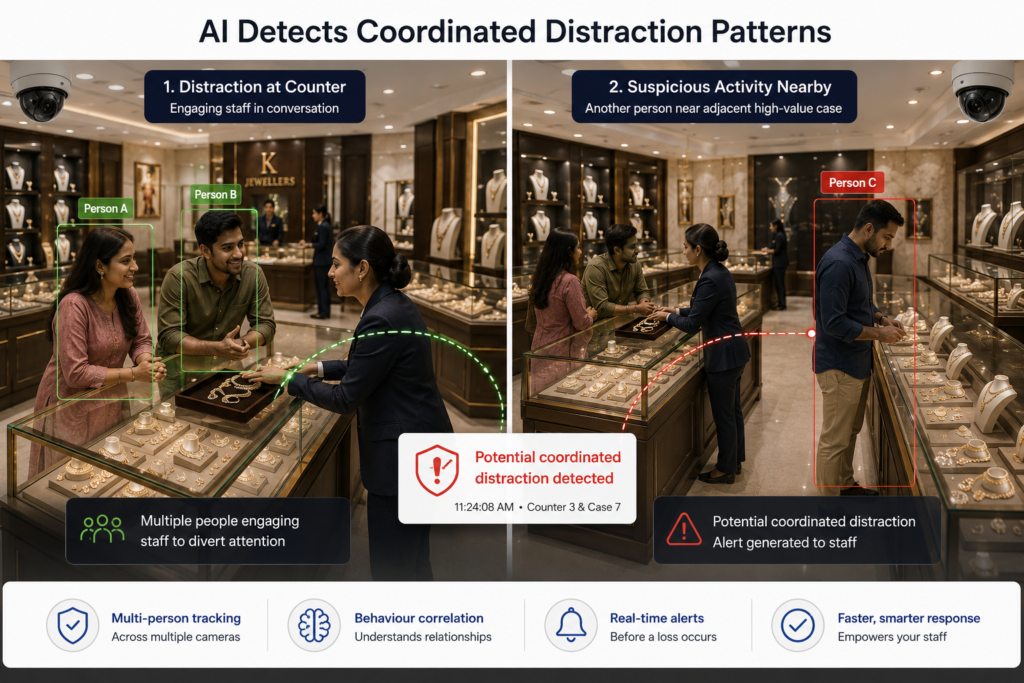
Coordinated distraction patterns
Organised theft in jewellery retail frequently relies on splitting staff attention. By tracking multiple people at once across multiple cameras, AI can recognise the signature of a distraction play — one group monopolising a counter while another works an adjacent case — and alert before the second move completes.
Beyond detection: standardised response
Catching an event is only half the value. The other half is making sure every alert triggers the same, calm, trained response — not improvisation. A good deployment pairs detection with a written alert SOP so a junior staffer at 11 a.m. responds exactly as the floor manager would. We cover this in detail in Building an Alert SOP for Jewellery Retail, and the case-specific protections in Protecting High-Value Display Cases with Video AI. The combination — reliable detection plus a rehearsed SOP — is what turns analytics into measurably lower shrinkage.
Privacy and compliance in the Indian context
Jewellery showrooms handle footage of customers, many of them regulars, and increasingly must account for India’s Digital Personal Data Protection (DPDP) Act when they process that footage. A privacy-first architecture matters here: processing video on-premise or at the edge means raw footage never has to leave the store, faces need not be retained, and demographic or behavioural signals can be derived without exporting identifiable data to a third-party cloud. This keeps data sovereignty in your hands and simplifies the consent and retention story you owe customers and regulators.
Deploying without a rip-and-replace
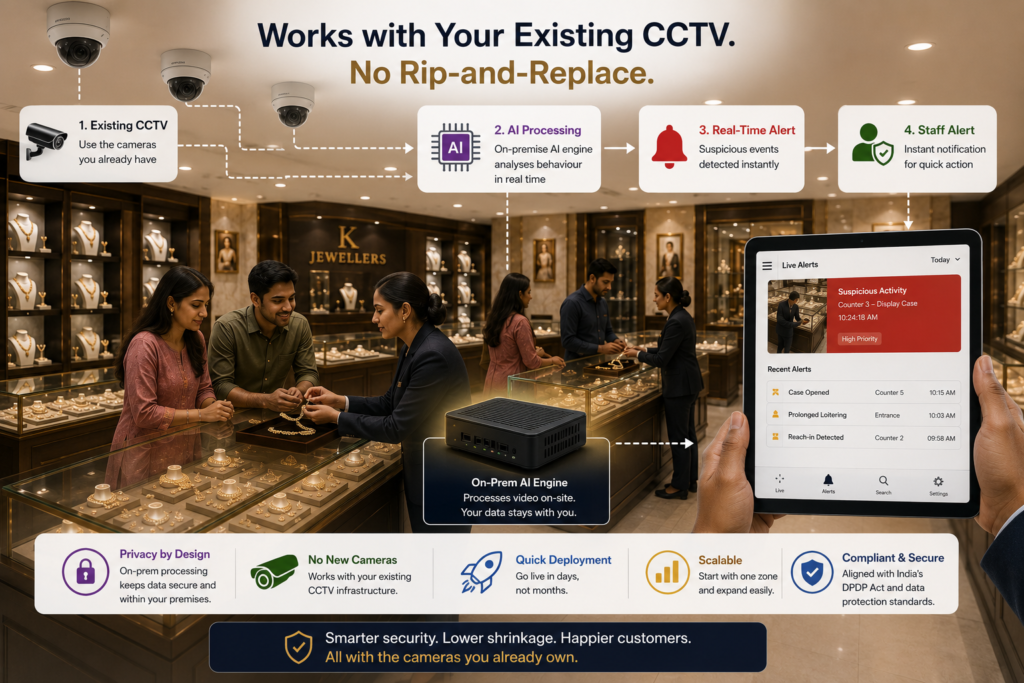
The biggest myth in jewellery security is that AI means new cameras. It does not. Modern video AI is camera-agnostic and works with the CCTV you already have — the analytics layer sits behind your existing feeds. KenVision is built around exactly this approach: it runs on your current cameras, processes on-prem or at the edge for privacy, and deploys fast so you are not closing the showroom for an integration project. You can explore the broader capability set on our retail analytics solution page.
A practical rollout usually looks like this: start with the highest-value zone (the diamond or gold display wall), tune the behaviour models to your floor over the first weeks to suppress false alerts, codify the alert SOP with your staff, then extend coverage to billing and entrance zones. Because nothing is being physically replaced, the incremental cost of adding zones is low.
What to measure
Treat theft detection like any other operational system and hold it to numbers: alert precision (how many flags are genuine), response time from alert to staff action, shrinkage variance at stock-take versus the prior period, and incident near-misses caught before a loss. Capability claims are easy to make; the showroom that wins is the one that reviews these metrics monthly and keeps tuning.
Frequently asked questions
Do I need to replace my existing CCTV cameras?
No. AI theft detection is camera-agnostic and layers onto the feeds from your current showroom cameras. The analytics engine reads existing video, so there is no rip-and-replace and no extended showroom closure.
Will customer footage leave my premises?
With a privacy-first, on-prem or edge deployment, raw footage is processed locally and need not be sent to an external cloud. This supports data-sovereignty expectations and simplifies compliance with India’s DPDP Act.
Can AI tell a genuine try-on from an actual theft attempt?
It reasons about behaviour and context — dwell, coordination, case-open and reach-in events — rather than firing on simple motion. This greatly reduces false alarms compared with sensor-only systems, and the models are tuned to your specific floor during onboarding.
How fast can it be deployed in a working showroom?
Because it uses existing cameras and processes on-site, deployment is fast and typically starts with your highest-value display zone before extending to billing and entrance areas.
Does detection alone reduce theft?
Detection plus a standardised alert SOP is what reduces loss. The alert tells staff something is happening; the SOP ensures every alert gets the same trained, calm response.
See it on your own floor
The fastest way to judge whether AI theft detection fits your showroom is to see it run against a real jewellery-retail scenario. Book a 30-minute demo and we will walk through how KenVision works with your existing CCTV, on-prem, with privacy built in.