Crowd Density Monitoring: How AI Prevents Crush Risk at Public Events
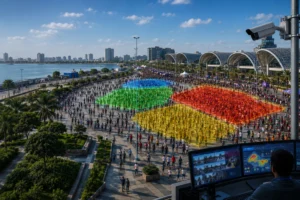
Public events bring together thousands and sometimes millions of people within a limited space. From religious festivals and pilgrimage routes to stadiums, political rallies, transit hubs, and concerts, managing crowd movement is one of the biggest public safety challenges. When crowd density rises too quickly or pedestrian flow slows unexpectedly, the risk of congestion, panic, and crowd crush incidents increases significantly.
Crowd density monitoring uses AI-powered video analytics to continuously measure how many people occupy a specific area using existing CCTV cameras. Instead of relying on operators to manually monitor dozens of video feeds, the system detects overcrowding, tracks crowd movement, and sends real-time alerts before conditions become unsafe.
This guide explains how crowd density monitoring works, why it matters, and how organizations can deploy it on existing CCTV infrastructure while maintaining privacy.
What Is Crowd Density Monitoring?
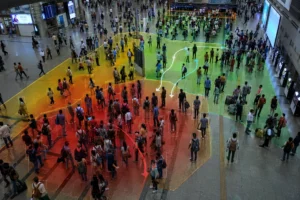
Crowd densitymonitoring is an AI-based video analytics solution that estimates the number of people within a defined area, typically measured as people per square metre. It continuously analyzes camera feeds to monitor crowd levels, detect congestion, and identify potential bottlenecks.
Unlike facial recognition systems, crowd density monitoring focuses on aggregate crowd behavior, not individual identities. It measures how crowded an area is, how quickly density is changing, and whether pedestrian movement is flowing normally or slowing down.
The key metrics include:
- Density – Number of people occupying a specific area.
- Flow – Direction and speed of pedestrian movement.
- Trend – Whether crowd density is increasing, decreasing, or remaining stable.
These insights help operations teams identify potential risks before they become emergencies.
Why Crowd Density Monitoring Matters
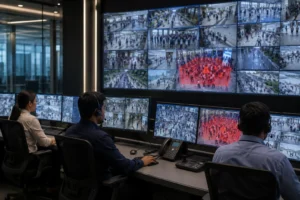
Many large venues already have extensive CCTV coverage. The challenge isn’t the lack of cameras—it’s the ability for operators to monitor every camera feed at once.
During busy periods, control room staff can easily miss early signs of overcrowding while switching between multiple screens.
AI-powered crowd monitoring solves this by continuously analyzing every connected camera and automatically highlighting areas where crowd density is rising beyond safe thresholds.
Instead of reacting after congestion occurs, teams receive early warnings that allow them to:
- Redirect pedestrian traffic
- Open alternative entry or exit routes
- Temporarily control inflow
- Deploy security personnel
- Prevent dangerous bottlenecks
This enables a proactive rather than reactive approach to crowd management.
Where Crowd Density Monitoring Is Used
Crowd density monitoring is valuable anywhere large numbers of people gather.
Common applications include:
- Religious festivals and pilgrimage sites
- Stadiums and sports venues
- Railway stations and metro terminals
- Airports
- Concerts and live events
- Political rallies
- Shopping malls
- Exhibition and convention centres
- Smart cities and public spaces
In each of these environments, AI provides continuous visibility into crowd conditions that would otherwise be difficult to monitor manually.
How AI Crowd Density Monitoring Works
The process is straightforward:
- Existing CCTV cameras capture live video.
- AI analyzes each video stream in real time.
- The system estimates people per square metre within predefined zones.
- Heat maps visualize crowded areas.
- Alerts are generated when density or flow crosses configured thresholds.
- Operators verify the alert and initiate the appropriate response.
Because the solution works with existing IP cameras and analog cameras connected through encoders, organizations can deploy it without replacing their surveillance infrastructure.
AI Monitoring vs Manual Monitoring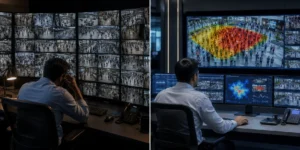
| Manual Monitoring | AI Crowd Density Monitoring |
|---|---|
| Operators monitor multiple screens | Every camera is analyzed continuously |
| Relies on human observation | Detects risks automatically |
| Easy to miss developing congestion | Real-time alerts before overcrowding |
| Reactive response | Proactive intervention |
| Difficult to scale | Supports hundreds of cameras simultaneously |
Rather than replacing security teams, AI helps them focus on the locations that require immediate attention.
Benefits of Crowd Density Monitoring
Organizations adopting AI-powered crowd monitoring gain several operational advantages:
- Detect overcrowding before it becomes dangerous
- Monitor pedestrian movement in real time
- Identify bottlenecks and congestion
- Improve emergency response times
- Reduce operator fatigue
- Generate historical crowd analytics
- Improve event planning and resource allocation
- Use existing CCTV infrastructure
- Support privacy-first deployments
These capabilities improve both public safety and operational efficiency.
Deploying on Existing CCTV Infrastructure
One of the biggest advantages of modern crowd density monitoring is that it works with existing surveillance systems.
Organizations can integrate AI with their current IP cameras or analog cameras without replacing hardware.
Edge or on-premises deployment keeps video processing inside the organization’s network, reducing latency while avoiding the need to stream large volumes of footage to the cloud.
This approach offers:
- Faster alert generation
- Lower bandwidth usage
- Better data security
- Improved operational reliability
- Easier compliance with privacy requirements
For temporary events such as festivals or concerts, the system can also be deployed on portable edge devices for the duration of the event.
Privacy by Design
Crowd density monitoring does not require facial recognition.
The system analyzes crowd movement and occupancy levels rather than identifying individuals. It generates aggregated insights such as density, flow, and congestion instead of collecting personal information.
Processing video on-premises further strengthens privacy by ensuring footage remains within the organization’s network while still delivering real-time analytics.
This makes AI crowd monitoring a practical solution for organizations seeking to improve public safety while respecting privacy requirements.
Getting Started
Most organizations begin with a small deployment focused on high-risk locations such as entrances, exits, footbridges, or transit corridors.
After calibrating density thresholds for each location and integrating alerts into the control room workflow, the solution can gradually expand across the venue.
Because AI works with existing CCTV infrastructure, organizations can improve crowd safety without significant hardware investment.
Frequently Asked Questions
What is crowd density monitoring?
Crowd density monitoring uses AI and CCTV cameras to estimate how many people occupy a defined area in real time. It helps identify overcrowding, monitor pedestrian flow, and generate early warnings before safety risks develop.
Does crowd density monitoring identify people?
No. The technology measures crowd density and movement patterns rather than identifying individual people, making it suitable for privacy-focused deployments.
Can it work with existing CCTV cameras?
Yes. Most AI crowd monitoring platforms integrate with existing IP cameras and analog cameras connected through encoders, allowing organizations to upgrade their surveillance systems without replacing hardware.
How are alerts generated?
Alerts are triggered when crowd density or pedestrian flow exceeds predefined thresholds. Operators receive real-time notifications so they can respond before congestion becomes critical.
Which industries benefit from crowd density monitoring?
The technology is widely used in public events, stadiums, transportation hubs, smart cities, shopping malls, airports, religious venues, and large public spaces where crowd safety is essential.
Improve Crowd Safety with AI
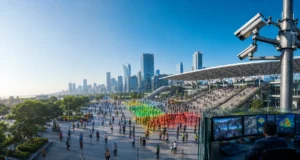
Real-time crowd density monitoring gives operations teams the visibility they need to respond before congestion turns into a safety incident. By combining AI-powered video analytics with existing CCTV infrastructure, organizations can improve crowd management, reduce operational risk, and enhance public safety without replacing their surveillance systems.
Whether you’re managing a stadium, transit hub, public event, or smart city project, AI-powered crowd monitoring helps transform CCTV from a passive recording system into an intelligent early-warning solution.